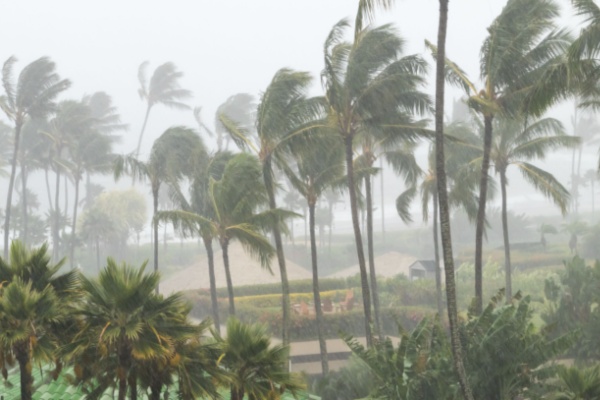
Hawaii just can’t catch a break this year. The Super El Niño season is making for an unheard-of mild Atlantic Hurricane season, but breaking records to disastrous effect in the Pacific, especially for the Hawaiian Islands.
Although Hawaii has historically avoided the worst effects of hurricanes in the Eastern Pacific, in 2026, two significant hurricanes: Lowell and Lala, have already hit the islands and hit them hard, leaving a trail of damage and devastation in their wake. Now Hawaii is once again facing its biggest tropical threat so far this hurricane season with the newly named Tropical Storm “Nolo,” forecast to become a Category 3 storm as it nears the Big Island into the weekend.
As AccuWeather reports, the impacts from Nolo could be even more severe than Hurricane Lala, which left residents of the Big Island in “total shock” due to the magnitude of the damage. Communication was cut off for some areas, with the hardest-hit areas of Hawaii being without power for over a week. “Due to the slow movement of the storm late this week, there is a growing potential for this to be a long-lasting, life-threatening rain event that could last through the weekend,” AccuWeather Lead Hurricane Expert Alex DaSilva said.
The Big Island is predicted to experience the worst of the storm, with the center of Nolo tracking just to the south. If the storm ends up tracking farther north, it could make landfall. “It is becoming more likely that the storm will track close enough to the islands to allow for widespread, life-threatening rainfall on the Big Island of Hawaii, along with mudslides and strong winds,” DaSilva said. “Areas damaged by Lala can be especially vulnerable.”
Potentially catastrophic rainfall for the Big Island
Northern portions of Maui can receive 8-12 inches with some areas along the northeastern slopes getting 12-18 inches. The highest rainfall totals are expected across the eastern slopes of the Big Island, where widespread amounts of 24-36 inches are predicted.
Hurricane Lala was close to being the first-ever hurricane to make landfall on the Big Island, but the center of the storm passed about 40 miles to the south of the island on Aug. 16. Lala was still close enough to unleash 43.54 inches of rain at Laupahoehoe, Hawaii, and 140-mph winds at the summit of Mauna Kea.
Nolo’s rain has the potential to be even more intense.
If rainfall from Nolo reaches AccuWeather‘s Local StormMax™ of 55 inches, it would become the second-wettest hurricane on record for Hawaii. Hurricane Lane unleashed 58 inches of rain in 2018, surpassing Hurricane Hiki which previously held the record at 52 inches in 1950. “Due to life-threatening flooding rainfall, mudslides, storm surge and damaging winds, this tropical depression is a 2 on the AccuWeather RealImpact™ Scale for Hurricanes in Hawaii,” DaSilva said.
Widespread power outages possible across Hawaii
Wind gusts of 40-60 mph will spread across Hawaii and Maui counties. Stronger winds can occur across the southern portions of the Big Island as well as across higher elevations. These winds can cause some structural damage and bring down trees and power lines, including areas that faced extensive outages last month in the wake of Lala.
The slow movement of the storm will also result in prolonged storm surge along southern- and east-facing beaches. “A storm surge of 1-3 feet is possible across the southern side of the Big Island, with an area of 3-6 feet possible as well,” AccuWeather Meteorologist Breanna Grill said.
It’s all that Super El Niño’s Fault
Hawaii has faced more tropical threats than normal this hurricane season amid a strengthening El Niño. Unusually warm waters linked to El Niño have provided ample fuel for the tropical storms and hurricanes, starting with Lala in mid-August and followed by Tropical Storm Moke and Hurricane Lowell.
Hawaii rarely experiences direct impacts from several tropical storms or hurricanes in the same year, as it has in 2026. In most years, the state does not experience even one. Only four tropical systems on record have passed within 100 miles of the islands during October, November or December.
—
Photo Credit: Ryan DeBerardinis / Shutterstock.com
