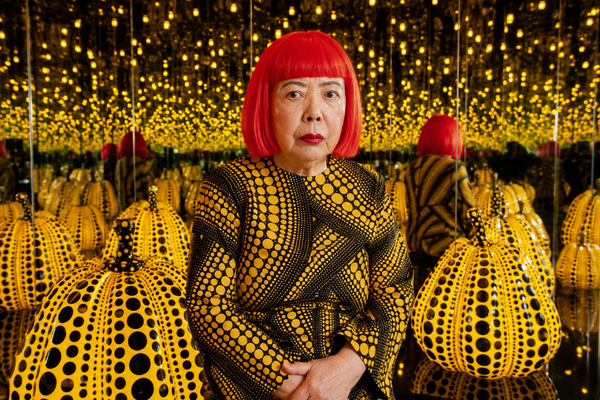
Yayoi Kusama, the Japanese artist who transformed dots, mirrors and pumpkins into an unmistakable visual universe, has died at 97.
Kusama died Aug. 14 at a hospital in Tokyo, according to her studio, bringing to a close a career that stretched across more than seven decades and ultimately made her one of the world’s most recognizable contemporary artists.
Her rise was anything but conventional.
Born in Matsumoto, Japan, in 1929, Kusama began making art while young and described experiencing hallucinations involving patterns and objects that seemed to multiply around her. Those experiences would become deeply connected to her work, particularly the obsessive repetition of dots, nets and other shapes that became her artistic signature.
Kusama pursued art despite resistance at home and eventually left Japan for the United States. By the late 1950s, she was establishing herself in New York, where the city’s experimental art scene offered both opportunity and formidable competition.
Her large-scale Infinity Nets paintings demonstrated the fascination with repetition that would follow her throughout her career. She soon expanded into sculpture, installations and performance art, becoming part of an avant-garde generation that challenged traditional definitions of what art could be.
Kusama also refused to quietly accept the limitations confronting women in the art world. Her performances and installations frequently pushed against social expectations involving gender and sexuality, while some of her public events became associated with opposition to the Vietnam War.
Attention did not translate into uninterrupted success.
Kusama returned to Japan in the 1970s as her international profile faded. Facing longstanding mental health struggles, she eventually chose to live in a psychiatric hospital in Tokyo. Rather than ending her career, the arrangement became part of a remarkable creative routine. She maintained a nearby studio and continued working.
Then came one of the art world’s great second acts.
International interest in Kusama steadily returned, leading to exhibitions at major museums and renewed recognition of her earlier contributions. Her Infinity Mirror Rooms became particularly popular. Visitors stepped into mirrored environments where lights and objects appeared to repeat endlessly, creating the sensation of standing inside an infinite landscape.
The installations found an enormous new audience in the social media era, but their origins stretched back decades. What appeared perfectly suited to the Instagram generation was rooted in ideas Kusama had explored long before smartphones existed.
Her pumpkins became another signature. Often brightly colored and covered in dots, the sculptures turned an ordinary form into something immediately identifiable as Kusama’s.
That distinctive visual language eventually escaped the traditional boundaries of galleries and museums. Fashion collaborations and other commercial projects brought her dots to an even wider public, while exhibitions drew crowds around the world.
Her career was not without controversy. In 2023, earlier writings containing offensive descriptions of Black people resurfaced and drew criticism. Kusama apologized for the language and said her intention through her art had been to promote respect and compassion.
Her broader influence, however, had already stretched across generations.
Kusama survived periods of obscurity, personal crises and an art establishment that did not always know what to make of her. She emerged in later life not merely as a rediscovered figure from the 1960s, but as a global cultural presence whose work attracted people who might rarely otherwise enter a contemporary art museum.
She also kept creating.
According to her studio, Kusama continued painting until her final days.
For an artist whose work repeatedly explored infinity, repetition and the possibility of something continuing beyond its apparent boundaries, there is a certain symmetry to the legacy she leaves behind.
The woman behind the dots is gone. The universe she created keeps expanding.
