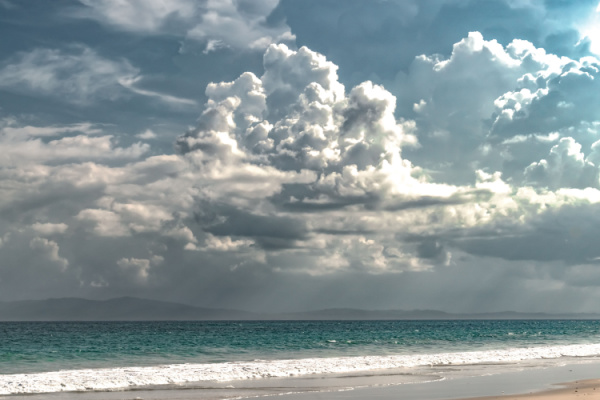
California faces additional coastal threats in October thanks to a spin-off from the developing super El Niño, known as a Kelvin wave, expected to bring a few inches to half a foot of sea-level rise, contributing to an already storm-stricken coast facing emergency coastal erosion.
What is a Kelvin wave, and how is it connected to El Niño?
As AccuWeather reports, a Kelvin wave is not a surf-like wave or a tsunami wave. It’s a pulse of warm water being driven across the equatorial Pacific Ocean by a burst of westerly winds. These are planetary waves that stretch thousands of miles and do not come and go quickly.
AccuWeather Lead International Forecaster Jason Nicholls explained how it is connected to the ongoing El Niño. “During a developing El Niño, trade winds weaken, and strong westerly wind bursts occur across the equatorial Pacific,” Nicholls said. This dramatic shift in the wind causes warm water concentrated over the western Pacific Ocean to surge eastward, eventually reaching the coastlines of North America and South America.
“The Kelvin waves generated by El Niño are called internal Kelvin waves, which are triggered by these changes in the surface winds,” Nicholls added. Kelvin waves come in two types. Downwelling waves carry warm water and raise sea levels, as in the current event. Upwelling waves bring colder water toward the surface, lowering sea levels and potentially dampening El Niño.
When will the Kelvin wave reach the U.S. Pacific Coast?
The wave won’t arrive all at once. It is a slow-moving process that plays out over thousands of miles. Satellite measurements of sea-level height show the wave has reached South America and is now spreading toward North America, Nicholls said. “The sea-level height anomalies are already over a foot off South America and are close to 6 inches in Baja California,” he said.
In early October, measurements are already showing the slow arrival of the Kelvin wave at U.S. beaches. “Sea-level height anomalies were up to 10 cm [about 4 inches] off the California coast and are already slightly elevated off the Northwest coast,” Nicholls said.
Later in October, he expects sea levels in California to run about 6 inches above normal, which would worsen coastal erosion. California Gov. Gavin Newsom declared a state of emergency in September over El Niño and its coastal impacts.
How much will the Kelvin wave raise sea levels in Oregon and Washington?
Oregon and Washington are bracing for a smaller but still noticeable sea level rise from the Kelvin wave. Nicholls estimates sea levels off the Northwest could be about 5 cm (2 inches) above normal by mid-October.
What impacts will a Kelvin wave have on coastal communities?
A few inches may not sound like much, but it matters during high tides and storms. With a higher baseline, storm surge can push farther inland and cause more flooding and beach erosion.
Already suffering from coastal erosion from back-to-back Pacific hurricanes and tropical storms, California is once again looking at dangerous surf from Hurricane Rachel, putting more property at risk.
Another problem with a higher sea-level baseline will happen around king tides, which occur around the new and full moons when the sun and moon line up and typically peak along the Pacific coast between November and February.
—
Photo Credit: Ashish_wassup6730 / Shutterstock.com
