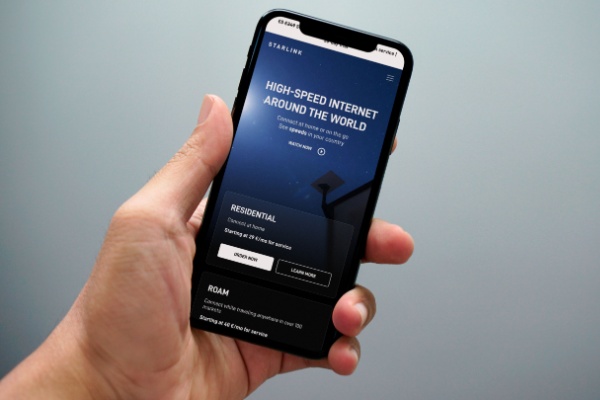
SpaceX is officially declaring that its satellite-to-phone service, Starlink Mobile, will become a major carrier in the US, putting it in direct competition with AT&T, T-Mobile, and Verizon.
As PCMag reports, the company made this announcement after acquiring a slice of radio waves from Grain Management, a private investment firm that bought the spectrum from T-Mobile. In the announcement, SpaceX noted: “This prime low-band spectrum addresses one of the key remaining technical gaps that will pave the way for Starlink Mobile to become a major mobile carrier in the US.”
SpaceX-Starlink’s Plan
The plan is to use both next-generation satellites and an “advanced terrestrial deployment” to offer cellular coverage. “This new low-band spectrum will provide a coverage layer that ensures Starlink Mobile’s signal penetrates through obstacles, such as walls, and can provide service to customers’ devices even when they are in buildings. Critically, most existing mobile devices already support this underused band,” the company added.
Specifically, SpaceX says it’s acquiring “up to 14 megahertz of paired spectrum” after the Federal Communications Commission (FCC) cleared Grain to take over the 817 to 824MHz and the 862 to 869MHz bands. Interestingly, rival provider AST SpaceMobile was testing its own satellites to use the radio bands, but it looks like SpaceX swooped in with a better offer.
Terms weren’t disclosed, and the FCC still needs to clear the SpaceX-Grain transaction. Still, the Elon Musk-led company is betting that “Starlink Mobile can now become the first network operator to deploy both satellite and terrestrial spectrum. One network that provides Americans with a reliable service indoors, outdoors, in cellular dead zones, and everywhere in between.”
SpaceX Already Acquired EchoStar
Last year, the company reached a collective $20 billion deal to acquire additional radio spectrum from Boost Mobile’s parent, EchoStar, to bulk up Starlink Mobile. On Tuesday, the FCC approved SpaceX’s application to launch 15,000 “version 2” satellites for Starlink Mobile and harness the EchoStar spectrum. In addition, the FCC cleared a regulatory path for the company to compete as a retail wireless provider in the US and is preparing further action to free up additional spectrum.
SpaceX can only begin using the EchoStar spectrum once the deal closes, which is slated for November 2027. The phone industry also still needs time to incorporate the chipsets that can use the EchoStar spectrum. So, when Starlink Mobile will launch as a retail wireless carrier remains unclear. Whether T-Mobile will dump SpaceX as a partner is another major question.
Other Mobile Carriers have been Dismissive
In the meantime, telecom experts and executives, including T-Mobile’s outgoing CFO, have been dismissive of SpaceX’s plan to use both satellite and cost-effective radio transmitters, called femtocells, to match the coverage and 5G capabilities of the big three carriers.
Ironically, T-Mobile is currently the exclusive US provider of the current version of Starlink Mobile, which uses about 650 satellites and offers speeds at around 4Mbps. The satellite service can eliminate cellular dead zones by providing texting and even data on select mobile apps. But in recent months, T-Mobile has been downplaying the satellite service and floating the possibility of working with rival providers.
On SpaceX’s announcement, satellite industry analyst Tim Farrar said: “I think this adds fuel to the fire in the battle between SpaceX and the mobile operators, but it’s still a very limited amount of spectrum and to get reliable building penetration in urban areas SpaceX would have to deploy an extensive network of towers on the ground which would be expensive.”
“They [SpaceX] will also need modified satellites if they hope to deploy this spectrum on their next-generation satellite constellation as an interim measure because the frequencies are much lower than the satellites were originally designed to use,” he added.
The same deal also cuts off an option for AST SpaceMobile to acquire more spectrum. Farrar expects the “attention will now focus on Viasat as one of the last remaining holders of a large amount of global spectrum.”
—
Photo Credit: Azulblue / Shutterstock.com
