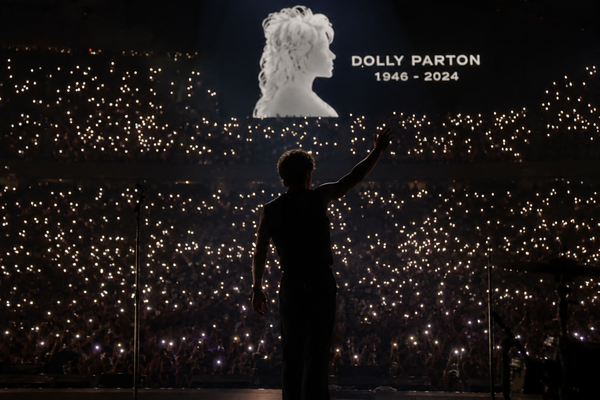
Harry Styles turned Madison Square Garden into a celebration of Dolly Parton as he honored the country music legend during his New York City concert Wednesday night.
During the Aug. 26 stop on his Together, Together tour, Styles took time to recognize the musicians who helped inspire his own career, singling out Parton and offering his thanks as the crowd responded with cheers.
Then came a song that needed little introduction.
Parton’s 1974 classic “I Will Always Love You” filled Madison Square Garden, but Styles chose not to take over the microphone for his own rendition. Instead, he encouraged the audience to dance as fans raised their phones and transformed the arena into a sea of lights.
Zoë Kravitz, Styles’ fiancée, was among those in attendance for the emotional moment.
The tribute came just one day after Parton died at age 80 following a brief battle with cancer, according to her representatives. News of her death prompted an outpouring of remembrances from across the music and entertainment industries.
Styles was not the only artist to turn to “I Will Always Love You” while remembering Parton.
John Mayer honored her Wednesday evening during a SiriusXM performance at Stephen Talkhouse in Amagansett, New York. Mayer played the song on guitar near the end of his set before moving into his own hit “Gravity.”
Beyoncé, Taylor Swift, Miley Cyrus and numerous other performers have also joined fans in remembering Parton and celebrating a career whose influence reached well beyond country music.
Parton sold more than 160 million albums worldwide during her career, while her work away from the stage became another major part of her legacy. Her Imagination Library has provided books to children from birth through kindergarten, making literacy one of the causes most closely associated with her name.
At Madison Square Garden, Styles kept his remembrance simple. There was no attempt to make Parton’s signature song his own. He gave the music to the crowd instead, allowing thousands of voices and lights inside one of the world’s most famous arenas to help say goodbye.
