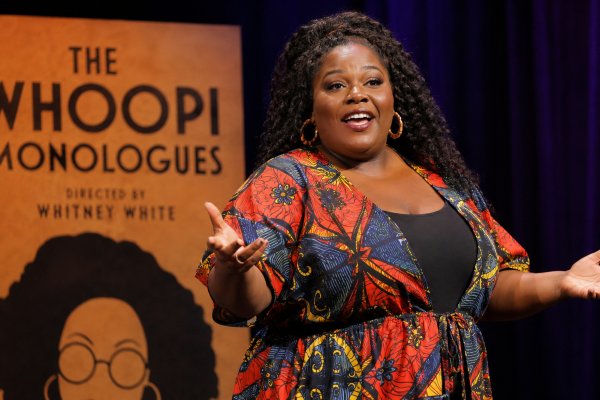
Danielle Pinnock’s journey to Lincoln Center began years before she became a familiar face on television.
As a teenager from New Jersey with ambitions in the arts, Pinnock went looking for performers who could show her that there was room for someone like her. At the New York Public Library for the Performing Arts, she found one of the clearest examples possible: Whoopi Goldberg.
A recording of Goldberg’s acclaimed one-woman show gave Pinnock something more valuable than inspiration. It gave her evidence that a performer could be unconventional, deeply individual and still build an extraordinary career.
Now Pinnock has returned to the same Lincoln Center world that helped shape her ambitions, this time as a performer in “The Whoopi Monologues,” a new staging connected to Goldberg’s groundbreaking work.
For Pinnock, the production carries both professional and personal weight. She has long viewed Goldberg as an artistic guide, and stepping into material associated with one of her greatest influences has created a rare full-circle moment.
The experience has also become a collaborative one. Pinnock credits director Whitney White with creating an environment where the cast can experiment, connect their own experiences to the material and build a sense of community around the production.
That connection is especially strong in Pinnock’s portrayal of the Jamaican Lady.
As a first-generation Jamaican American, she approaches the character with her own family history in mind. Her parents and grandparents experienced the challenges, uncertainty and unexpected turns that can come with immigration, giving Pinnock a personal foundation for the role.
She has also put considerable effort into the character’s language and cultural authenticity. Jamaican comedian Oliver Samuels helped coach her performance, while Pinnock’s mother worked with her on the Patois during the audition process.
The attention to detail reflects something larger for Pinnock. She sees the character not simply as a source of comedy, but as a woman whose story touches on survival, exploitation, migration and hope.
That combination is one reason Pinnock believes Goldberg’s material still connects with audiences decades after it was created. The characters can be funny without becoming shallow, political without losing their humanity and specific without becoming inaccessible.
The audience, Pinnock says, also plays an unusually active role.
Each performance develops its own rhythm depending on how people respond in the room. Unexpected comments can spark improvisation, turning sections of the show into spontaneous exchanges between performers and theatergoers.
That freedom suits Pinnock, whose comedic instincts allow her to react in the moment rather than treating the material as something untouchable. The result can feel less like a formal theatrical presentation and more like a shared gathering where laughter, reflection and emotion coexist.
Pinnock’s interest in turning personal experiences into communal storytelling has shaped much of her own creative work.
Her solo production “Body/Courage” began with more than 300 interviews examining how people relate to their bodies. Pinnock started the project while wrestling with her own insecurities about being plus-size and questioning whether her body would limit her opportunities or relationships.
The interviews expanded her perspective.
People from dramatically different backgrounds shared concerns about health, aging, appearance and physical vulnerability. Pinnock came away from the project with a stronger sense that many of the insecurities people consider deeply personal are far more universal than they seem.
“Body/Courage” eventually became a 90-minute stage production in Chicago and drew enthusiastic audiences. Its success became an important turning point in Pinnock’s career and reinforced her belief in storytelling built from real, complicated human experiences.
Now she is preparing to explore another difficult subject.
After losing her best friend and mentor, Pinnock began developing a follow-up project focused on grief, mental health, perfectionism and the disruption that can follow when someone accustomed to pushing forward reaches an emotional breaking point.
That willingness to examine vulnerability runs alongside a practical streak in the way Pinnock approaches her career.
Advice from Viola Davis encouraged her to think clearly about financial responsibility, professional representation and the importance of asking for what her work is worth. Pinnock says that perspective helped reshape the direction of her career.
Today, those lessons about confidence, identity and legacy have converged in “The Whoopi Monologues.”
Pinnock once watched Goldberg’s work hoping to find evidence that an unconventional young performer could belong in the industry. Years later, she is helping carry that work forward for another audience.
Her hope is that people leave the theater not only entertained, but motivated to think about what they might create, contribute and leave behind themselves.
