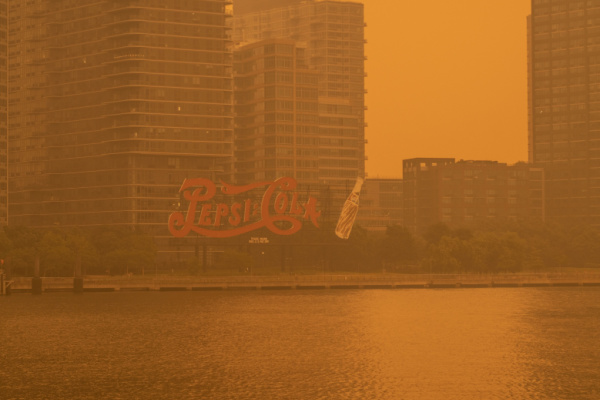
Massive plumes of smoke are descending across parts of Canada and the United States, creating dangerous air quality and scenes reminiscent of the historic wildfire smoke outbreak from three summers ago.
As AccuWeather reports, air quality alerts have been issued for millions of people, including across all of Delaware, Maryland, Michigan, New Jersey, Ohio, Pennsylvania, and Wisconsin. “In 2023, a major fire outbreak in Quebec caused days of unhealthy air quality in the northeastern U.S.,” AccuWeather Vice President of Forecast Operations Dan DePodwin said. “This event could cause similar levels of poor air quality in spots.”
Over 800 wildfires are currently burning across Canada, including dozens that are out of control across western Ontario, the source of most of the smoke. “Many of these fires may have been started by lightning,” AccuWeather Senior Meteorologist Brett Anderson said.
Conditions started to deteriorate across the region last week, becoming more widespread as the days went on. People across the mid-Atlantic, including New York City, could smell smoke when stepping outside on Thursday afternoon.
On Friday morning, “dangerous” air quality was commonplace from northern Minnesota through Delaware. Chicago was one of the worst cities for air quality with an AQI of 342. The AQI was also over the “dangerous” threshold of 250 in Washington, D.C., Pittsburgh, Cleveland and Detroit.
“When the AQI climbs into the 150+ range for a full day outside, that’s in the ballpark of [smoking] 7 to 9 cigarettes,” Dr. Jonathan M. Tan, division chief of General Anesthesiology at Children’s Hospital of Philadelphia, told AccuWeather.
At these extreme levels, exposure to the air for a few minutes can lead to serious health effects, including difficulty breathing, throat irritation, itchy eyes, or a headache, according to Plume Labs. Experts encourage people to avoid outdoor activities until conditions improve.
The difference between Tuesday and Wednesday at Niagara Falls was startling as an orange-gray shroud settled over the iconic waterfall. Visibility improved over the falls by Friday, but air quality remained very unhealthy.
Fires burning in northern Manitoba, Saskatchewan and the Northwest Territories are also contributing to the smoky sky across North America. Most of the smoke from these blazes is higher in the atmosphere.
People are encouraged to limit time outdoors amid the poor air quality, especially for sensitive groups. Spending time outdoors and exercising could increase the risk of impacts, including difficulty breathing, throat irritation and itchy eyes. “Make sure to keep pets indoors to limit their exposure to poor air quality,” Grill added.
The smoke can also limit temperatures amid an ongoing heat dome, and where the smoke is not as thick in the sky, create vivid sunrises and sunsets.
—
Photo Credit: 120alpa.ca / Shutterstock.com
