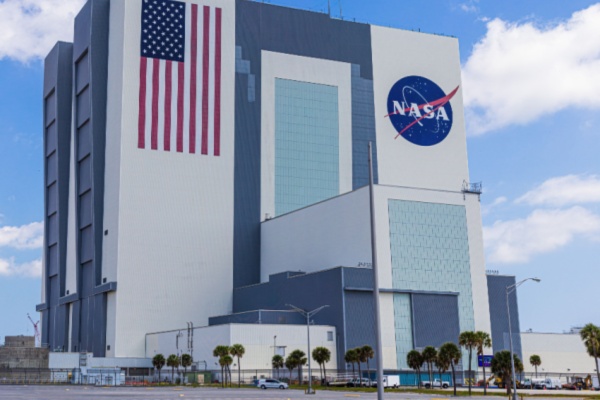
For the first time in more than 50 years, humans will strap themselves on top of a rocket and head farther than ever before into space. The launch, which has been delayed a few times (it was first set to launch 3 years ago in 2023), is now looking very good to launch from NASA’s Kennedy Space Center in Florida on Wednesday, April 1, 2026.
As Florida Today reports, the Artemis II launch this week sets several firsts but even beyond that, it’s one of the first steps planned to establish a base on the moon, with a goal of later heading to Mars.
The Rocket to the Moon
According to NASA, the onsite countdown clock started ticking down at 4:44 p.m. EDT to a targeted launch time of 6:24 p.m. on Wednesday, April 1. Artemis II has many firsts, and one of them is that it will be the first crewed launch of NASA’s SLS (Space Launch System) rocket and Orion spacecraft. NASA’s SLS rocket is 322 feet tall. That’s taller than the Statue of Liberty’s 305 feet but still smaller than the 363-foot-tall Saturn V.
It’s also the most powerful rocket NASA has ever launched, with 8.8 million pounds of thrust. On top of the SLS rocket is the Orion crew capsule. NASA is looking to establish a permanent foothold on the moon’s south pole, using a series of crewed and uncrewed missions in the years ahead to build a moon base before possibly venturing to Mars.
Making a List and Checking it Twice
With countdown officially underway, engineers are powering up flight hardware, checking communication links, and preparing the rocket’s cryogenic systems for the precise fueling sequence required to load hundreds of thousands of gallons of super-cooled liquid hydrogen and liquid oxygen. At Launch Pad 39B, teams will begin filling the sound suppression system’s massive tank with water, which will unleash a protective deluge at liftoff to shield the vehicle from the roar of its own engines.
Making History
It’s been more than 50 years since the last time America has gone to the moon. Astronauts have not traveled beyond Earth’s orbit since the 1972 Apollo 17 mission.
Artemis II also will be about 250,000 miles in space — farther than the record-setting Apollo 13 mission.
Astronauts on board also will see sights on the far side of the moon never before seen by humans.
Astronaut Christina Koch is expected to make history by becoming the first woman to travel around the moon and journey farther into space than any woman.
NASA astronaut Victor Glover is set to make history as the pilot of the Artemis II mission, becoming the first Black astronaut to travel to the moon.
Jeremy Hansen was selected to be an astronaut by the Canadian Space Agency (CSA) in 2009 and given the first opportunity for a Canadian to fly to the moon. He had to wait until 2023 to be named Mission Specialist for Artemis II.
Who’s On Board?
The Artemis II crew, NASA astronauts Reid Wiseman, Victor Glover, and Christina Koch, and CSA (Canadian Space Agency) astronaut Jeremy Hansen, remains in Astronaut Crew Quarters inside NASA Kennedy’s Neil A. Armstrong Operations and Checkout Building.
The crewmates have spent the final countdown phase focused on readiness and technical verification, remaining in quarantine under strict health monitoring and completing medical checks to ensure fitness for launch. They have been following a controlled sleep schedule and nutrition plan to maintain energy and hydration for launch, while continuing to receive regular updates on the rocket’s configuration and weather conditions from crew quarters.
Orange is the New Space Suit
The spacesuits designed for the Artemis II mission are purposeful, with the high-visibility orange helping make them stand out.
As Space.com reports, unlike suits intended for walking on the lunar surface, these suits are built for phases when the crew is inside Orion: launch, ascent, in-space contingencies and the demanding return through Earth’s atmosphere. This is because, while Artemis II is the first crewed mission to return to the area around the moon, the mission won’t actually land on the lunar surface itself. Instead, the four astronauts will take a 10-day journey around the moon to help calibrate systems for future missions (like Artemis III), which will actually land on the moon.
The suits for Artemis II, therefore, are engineered to protect the astronauts inside the Orion spacecraft, in case cabin pressure is lost or the life-support features integrated into the suit are needed, acting in a sense as each astronaut’s own personal space pod.
Weather Looks Good
Forecasters continue to predict an 80% chance of favorable weather throughout the window, but warn that possible afternoon cloud buildups and isolated showers could prompt brief delays to allow time for clouds or rain to move out of the launch area.
How to Watch
Broadcast coverage begins with live views and audio commentary of tanking operations beginning at 7:45 a.m. on April 1, on NASA’s YouTube channel, as teams load propellant into the SLS rocket. Full coverage on NASA+ begins at 12:50 p.m. Learn how to watch NASA content through a variety of online platforms, including social media.
—
Photo Credit: Framalicious / Shutterstock.com