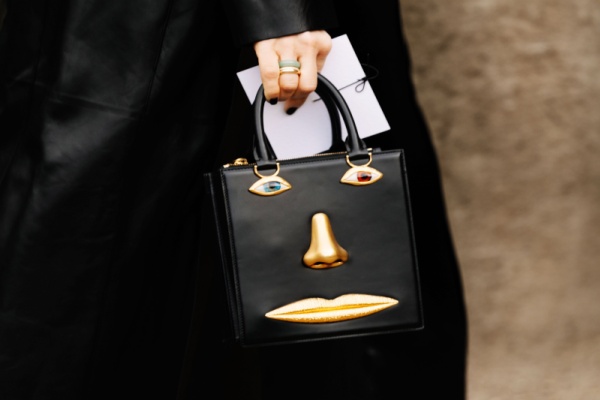
Fashion has long danced alongside the medium of art, with designers taking inspiration from the work of history’s great artists. With its technical prowess and avant-garde ambitions, many would argue that fashion belongs on the same plane as painting or sculpture.
Can the act of wearing a bold or even challenging dress change the way we see the status quo, beauty standards or the purpose of clothing itself? As CNN reports, it can — and designer Elsa Schiaparelli herself showed us precisely how over a handful of decades in the early 20th century.
As Wallpaper reports, the designer’s immeasurable impact on British art and cultural history is brought to the fore at V&A South Kensington’s excellent ‘Schiaparelli: Fashion Becomes Art’, which opened on March 28. The first of its kind in the UK, the show comprises over 200 objects, including garments, accessories, jewelry, paintings, photographs, sculpture, furniture and perfumes, from the 1920s to the present day – with a particular emphasis on the reciprocal relationship that Schiap, as she was known, had with the avant-garde art scene of interwar Europe.
Shiaparelli was an Enthusiastic Collaborator with Artists
Like others in the movement, Schiap – as she was known amongst her peers – was an enthusiastic collaborator. The exhibition is peppered with examples of works created in conjunction with her artistic contemporaries, from the iconic bust-shaped perfume bottle for ‘Shocking’, designed by Argentinian artist Leonor Fini, to the A-line dress with Dalí’s phallic painted-lobster printed onto its skirt, worn by Wallis Simpson before her marriage to Edward VIII, or a painted screen and Garden of Earthly Delights-esque collage by Marcel Vertès.
“Elsa Schiaparelli was someone who surrounded herself with artists,” such as Man Ray, Jean Cocteau and Salvador Dali, said Sonnet Stanfill, the V&A’s senior curator of fashion. “It wasn’t just Schiaparelli appropriating Surrealist images and sticking them on her clothes. She was someone who was embedded in the creative process, and there was a true collaborative, creative exchange with these artists and creatives.”
Schiaparelli First Brought Surrealism to London
According to Wallpaper, it was actually Schiaparelli who first brought surrealism to London – three years before the landmark London ‘International Surrealist Exhibition’ opened in 1936. When the Italian fashion designer introduced her extraordinary designs to Britain via her Mayfair store, it became the first surrealist space in the country. It is hard to imagine how the sight of this very foreign incarnation of flamboyance and glamour would have appeared to Depression-era Londoners, but, of course, Schiaparelli lived to shock.
Hailing from an intellectual and aristocratic family in Rome, and with no formal fashion training, Schiaparelli’s clothing could be challenging or, to use one of her favorite words: shocking. While peers like Coco Chanel or Christian Dior made clothing that was radically simple or effusively beautiful, Schiaparelli embraced what was surprising, in bad taste or even revolting (a pair of 1938 monkey fur boots, for example). Schiaparelli created clothes like a standup comedian or a philosopher with a flair for the opulent: What if a shoe were a hat? What if a circus-themed jacket had buttons sculpted like horses?
Unlike some of the other artists in Breton’s surrealist orbit, Schiap wasn’t utilizing techniques such as automatic drawing or harnessing the subconscious to unlock creative potential, yet her preoccupation with quintessential surrealist themes and motifs – the uncanny, the fragmented, the animalistic – placed her firmly within their world. A silk dress from the 1938 ‘Circus’ collection is printed to look like fabric being torn away to expose pink negative space beneath; the inspiration for the silhouette is taken from Salvador Dalí’s Necrophiliac Spring (1936), but the tromp l’oeil is pure René Magritte. An evening coat designed in collaboration with the artist, poet and filmmaker Jean Cocteau features the double image of two faces in profile and a vase of roses in bloom atop a plinth.
Virtually every fastening, whether zip or button, is an opportunity for intrigue: a smart wool suit is finished with discreet buttons featuring Commedia dell’arte masks, a sleeveless, body-contouring dress of ruched silk jersey features a suggestive front zip from hem to belly button.
Creative Director Daniel Roseberry Has Picked Up Her Mantle
Nearly 100 years later, her predecessor, present-day Maison Schiaparelli creative director Daniel Roseberry, picked up her mantle in 2019, combining thrilling design with the machinery of celebrity to change our notions of female beauty and power. The exhibition pairs their work together, showing the value of shocking style in a moment of conservatism. “There was a distance between culture and most French couture houses back then,” he said in an interview with Wallpaper. “Elsa’s focus wasn’t just on good taste or lifestyle or even beauty, it was more cerebral than that. It was about how the expression of the surreal can create a more intimate connection between art, pop culture and fashion and between the designer and client.”
That gave Schiaparelli’s clothing a sense of relevance in pre-World War II Europe’s cultural upheaval and aesthetically traditionalist Paris — a methodology that Roseberry has picked up in his contemporary take on her surrealist vision. In the final room of the exhibition, his boundary-pushing designs — a couture model clutching a robot baby, or a crisis-red gown whose bodice is eerily dense with beads — show how the idea of an unexpected ensemble can provoke and surprise, moving fashion and pop culture forward, where most clothing merely aims to please.
Where Schiap’s designs are full of subtle witticisms and cheeky visual puns, Roseberry’s tenure at the brand reads more like a nuclear bomb – bold, and unmissable. What was shocking or outrageous then just won’t cut it in the attention economy, and so the solution for Roseberry is to go bigger. “I think that this age will be remembered less for global conflict and more for the rise of social media, alternate realities and the lack of connection that we have with each other,” he says. “The language that Elsa used to address her political reality, we’re using to address our digital reality.
“My mission now is to pierce that digital veil and create moments of lasting connection. Fashion is ancient, it’s pre-biblical,” he continues. “People are always going to want to decorate, adorn, and express, but we’ve never lived in a more performative era. Designing a link between expression and genuine connection is something that feels urgent.”
The Schiaparelli: Fashion Becomes Art exhibit runs from now through November 8 at the Victoria & Albert Museum in London.
—
Photo Credit: photo-lime / Shutterstock.com
