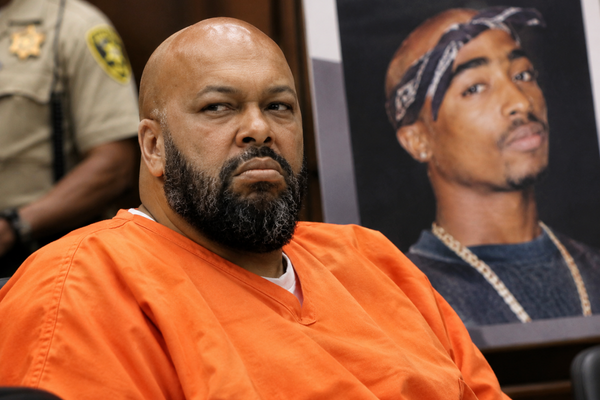
Nearly three decades after Tupac Shakur was gunned down in Las Vegas, the only living eyewitness to the shooting wants no part of the trial that could finally produce a verdict in the case.
Marion “Suge” Knight, the former Death Row Records executive who was behind the wheel when Shakur was shot in September 1996, has made clear that he does not want to testify in the murder trial of Duane “Keffe D” Davis.
Davis, 63, is the only person ever charged in connection with Shakur’s killing. He has pleaded not guilty to the murder charge. Prosecutors accuse Davis of helping organize the retaliatory attack that ended with gunfire striking the BMW carrying Shakur and Knight near the Las Vegas Strip.
Jury selection began in Las Vegas on August 10, bringing a case that has haunted hip-hop for almost 30 years into a courtroom.
Knight’s potential role is particularly significant because the other people authorities have connected to the Cadillac involved in the shooting are dead. That leaves the former music executive as a rare surviving firsthand witness to one of the most infamous moments in music history.
Knight, however, has shown no interest in helping prosecutors build their case against Davis.
He is currently serving a 28-year prison sentence stemming from an unrelated 2015 confrontation that led to his voluntary manslaughter conviction.
The prosecution’s case against Davis extends far beyond Knight’s potential testimony. Authorities have focused heavily on statements Davis made over the years concerning the night Shakur was shot, including accounts in interviews and a memoir. Davis has acknowledged being inside the Cadillac associated with the attack, while his defense has challenged the way his previous statements have been characterized and used against him.
Prosecutors contend the shooting followed a confrontation earlier that evening at the MGM Grand. Shakur and others became involved in an altercation with Orlando Anderson, Davis’ nephew. Authorities have long examined that confrontation as a possible catalyst for the violence that followed.
Shakur was shot while riding with Knight and died six days later at age 25.
His murder became far more than an unresolved criminal case. It grew into one of the defining mysteries of hip-hop history, generating decades of theories, documentaries, books and debate over who was responsible and why.
Now, with Davis standing trial and prosecutors revisiting evidence and statements stretching across decades, the case has reached a stage few would have imagined when Shakur died in 1996.
Whether Knight ultimately becomes part of that courtroom story remains uncertain. What is clear is that the man who survived the shooting alongside Shakur would prefer that the trial proceed without him.
