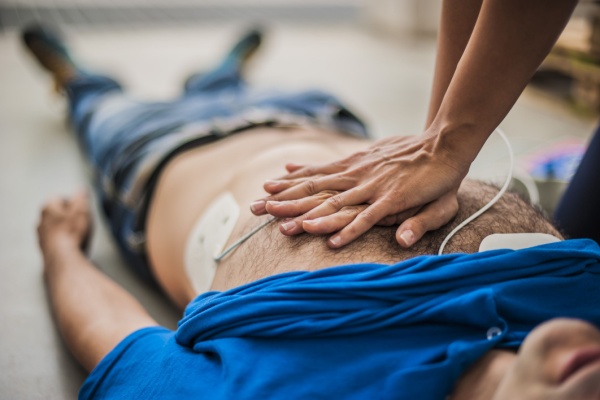
June 1-7 each year is National CPR and AED Awareness Week, spotlighting how lives can be saved if more Americans know CPR and how to use an AED.
Did you know about 70 percent of out-of-hospital cardiac arrests happen in homes? If you are called on to give CPR in an emergency, you will most likely be trying to save the life of someone you love. Be the difference for your parent, spouse, or child. What if it were them?
According to the Red Cross, each year, more than 350,000 cardiac arrests happen outside of hospitals in the United States. Most occur in homes or public settings where immediate medical help is unavailable. Yet only about 40% of cardiac arrest victims receive bystander cardiopulmonary resuscitation (CPR) before emergency medical services arrive — use of an automated external defibrillator (AED) is even lower, hovering just over 10%.
In an emergency, every second counts. During cardiac arrest — when the heart stops beating or beats too ineffectively to circulate blood to the brain and other vital organs — a victim’s chance of survival decreases by 10% for every minute without immediate CPR or defibrillation.
According to the American Heart Association, in 2007, the AHA in coalition with the American Red Cross and the National Safety Council worked collaboratively to designate a National CPR and AED Awareness Week federally. On December 13, 2007, Congress unanimously passed a resolution to set aside June 1-7 each year as National CPR and AED Awareness Week to spotlight how lives can be saved if more Americans know CPR and how to use an AED.
This week is a call to action for every American to:
- Get certified through accredited training programs
- Learn CPR skills (including Hands-Only CPR)
- Spread awareness within your workplace, school or community
- Understand how to use an AED
What is Hands-Only CPR?
Hands-Only CPR is a natural introduction to complete CPR training. Administering hands-only is something any bystander can do. Hands-only CPR requires you to push hard and fast in the center of the chest at a rate of 100–120 compressions per minute.
AEDs: A Vital Lifesaving Tool
AEDs (Automated External Defibrillators) are designed for easy use by lay responders. These lifesaving devices guide you step by step with voice prompts and only deliver a shock if one is needed. You’ll find AEDs in many public spaces like airports, gyms, schools and malls — but they’re only helpful if someone nearby can find them and is willing to use them.
Where to Get CPR & AED Training
Whether you are a healthcare worker, a workplace responder or a public member, the American Red Cross offers a variety of online, blended and instructor-led classroom courses, all compliant with public health guidance.
Several American Red Cross CPR and AED training courses satisfy requirements set by the Occupational Safety and Health Administration. Check with your employer to determine what class you need if you are taking CPR and AED training to fulfill a job requirement.
- Find a CPR/AED class near you
- Take an online or blended course
- Renew your certification
- Bring training to your workplace or school
You Can Be Ready to Act
Drew Ashley was flying with his family from Baltimore to West Palm Beach, Florida when a fellow passenger experienced a medical emergency. He and his dad, Anthony, both Red Cross CPR Instructors, administered CPR for 45 minutes until the airplane could make an emergency landing. Their actions saved a man’s life, and yours could too.
You won’t have time to think in an emergency — you’ll have to act. CPR & AED Awareness Week is the perfect opportunity to prepare and practice to protect the people you love.
Help spread the message of CPR & AED Awareness Week:
- Take or renew a CPR/AED class
- Post on social media using #CPRWeek and #SaveALife
- Host a workplace or school demo
- Check AED availability in your home, gym, or building
Your actions can make all the difference.
—
Photo Credit: pixelaway / Shutterstock.com
