Measles cases have surged to their highest levels since 1991, according to the latest data from the Centers for Disease Control and Prevention (CDC), with a former Food and Drug Administration (FDA) chief warning the case count is likely much higher than what is being reported.
The Numbers
So far in 2026, four confirmed deaths from measles have been reported in the United States. Initially, the year began with zero, but reports later indicated that two deaths occurred in Lancaster County, Pennsylvania, including a 40-year-old woman. As Fox News reports, just last week, an infant in Wisconsin died of measles, marking the state’s first death linked to the disease in 36 years, according to the state’s Department of Health Services.
As Forbes reports, a total of 5,182 measles cases have been recorded by the CDC so far this year, with 43 outbreaks accounting for the vast majority of cases. Measles cases have more than doubled since last year, when the CDC confirmed 2,289 cases throughout the U.S.
Scott Gottlieb, who served as the FDA’s commissioner from 2017 to 2019, during President Trump’s first Administration, said in a post Friday that the U.S. measles outbreak is “much larger than what’s reported.” Gottlieb also warned, “We will lose our Measles elimination status this month, and it will take years of responsible public health management to get it back.”
Behind The Numbers: The State of Vaccinations
Unvaccinated people or patients with an unknown vaccine status make up a whopping 96% of measles cases in the U.S., while people with one or two doses of the measles, mumps, and rubella vaccine cumulatively make up just 4% of cases.
Of the 5,182 cases, 562 have resulted in hospitalizations, with children under the age of five facing the highest hospitalization rate. About one in five unvaccinated people in the U.S. who get measles end up hospitalized, according to the CDC.
Health and Human Services Secretary Robert F. Kennedy Jr. did not immediately address the 2025 measles outbreak in the U.S. when it first appeared, declaring it was “not unusual.” Cases eventually grew to their highest in over 30 years, and Kennedy, a vaccine skeptic, encouraged people to get the vaccine but also continues to promote alternative treatments that have been debunked as having little effectiveness.
However, the U.S. Department of Health and Human Services previously told Fox News Digital that “Secretary Kennedy and CDC Director Dr. Erica Schwartz continue to make clear that the MMR vaccine is the most effective way to prevent measles.”
Dr. Natasha Chida, an assistant professor at the Johns Hopkins Division of Infectious Diseases, told Forbes early this year her team was concerned about current and future outbreaks because “we’re seeing a continued decline of vaccination rates.” The MMR vaccine has been around for well over 50 years and is proven to be safe and effective. The vaccine helped the U.S. reach elimination status in 2000, about 40 years after the country experienced a measles boom resulting in roughly 500,000 cases each year in the early 1960s.
Which States Have The Most Measles Cases?
Pennsylvania has the highest number of measles cases in the U.S., according to CDC data, logging 1,476 as of Friday afternoon. States with high case counts include South Carolina (670), Utah (536), Wisconsin (419), Kentucky (204), Ohio (202), and Virginia (182). See the full map here.
What Measles Is, and Isn’t
According to the World Health Organization (WHO), measles is one of the world’s most contagious diseases, spread by contact with infected nasal or throat secretions (coughing or sneezing) or breathing the air that was breathed by someone with measles. The virus remains active and contagious in the air or on infected surfaces for up to two hours. For this reason, it is very infectious. One person infected by measles can generate up to 18 secondary infections.
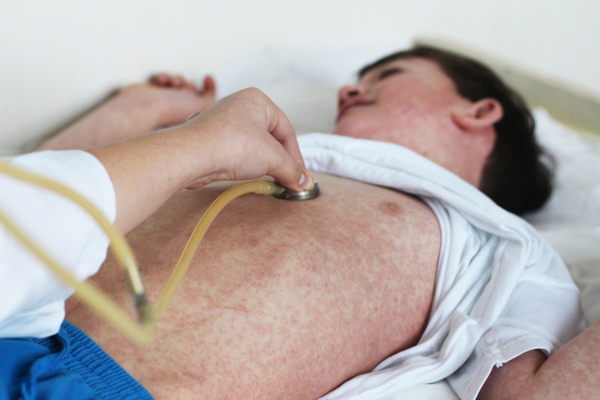
It can be transmitted by an infected person from four days prior to the onset of the rash to four days after the rash erupts. Symptoms of measles usually begin 7–14 days after exposure to the virus. A prominent rash is the most visible symptom.
Early symptoms usually last 4–7 days. They include:
- fever
- running nose
- cough
- red and watery eyes
- small white spots inside the cheeks.
The rash appears 3 to 5 days after the first symptoms, usually on the face and upper neck. It spreads over about 3 days, eventually downward to the trunk, arms, legs and feet. It usually lasts 4–8 days before fading.
Most deaths from measles are from complications related to the disease.
Complications can include:
- blindness
- encephalitis (an infection causing brain swelling and potentially brain damage)
- severe diarrhoea and related dehydration
- ear infections
- severe breathing problems including pneumonia.
If a woman catches measles during pregnancy, this can be dangerous for the mother and can result in miscarriage or her baby being born prematurely with a low birth weight.
Complications are most common in children under 5 years and adults over age 30. They are more likely in children who are malnourished, especially those without enough vitamin A or with a weak immune system from HIV or other diseases. Measles itself also weakens the immune system and can make the body “forget” how to protect itself against infections, leaving children extremely vulnerable.
Who is at risk?
Any non-immune person (not vaccinated or vaccinated but did not develop immunity) can become infected. Unvaccinated young children and pregnant persons are at highest risk of severe measles complications.
People at most risk for contracting measles include:
- Children too young to get a measles vaccine
- People who never had a measles vaccine
- People who did not get a second measles vaccine shot
- People who got a vaccine shot that did not work well
- People who travel to countries where the measles vaccine is not common, or those who are around people from these countries
- People who live in places where the vaccine might be easy to get, but many in that area choose not to get the vaccine
Measles can cause life-threatening complications, including pneumonia and swelling of the brain. While anyone can become seriously ill, children younger than 5, pregnant people, and people with weakened immune systems are at increased risk of complications.
Treatment
There is no specific treatment for measles. Caregiving should focus on relieving symptoms, making the person comfortable, and preventing complications.
Drinking enough water and treating dehydration can replace fluids lost to diarrhoea or vomiting. Eating a healthy diet is also important. Doctors may use antibiotics to treat pneumonia and ear and eye infections.
Two doses of vitamin A are recommended for all suspected measles cases in children under 5 years of age, immediately on diagnosis and repeated the next day, according to the dosing indicated by the health practitioner. A third dose is recommended for any clinical signs of vitamin A deficiency with eye complications and should be given 4–6 weeks later. This restores low levels of vitamin A that occur even in well-nourished children. It can help prevent other complications from measles, including eye damage and blindness. Vitamin A supplements may also reduce the number of measles deaths.
Prevention
The best way to treat measles is to prevent it. Community-wide vaccination is the most effective way to prevent measles. All children should be vaccinated against measles. The vaccine is safe, effective, and inexpensive.
Children should receive two doses of the vaccine to ensure they are immune. The first dose is usually given at 9 months of age in countries where measles is common and 12–15 months in other countries. A second dose should be given later in childhood, usually at 15–18 months. The measles vaccine is given alone or often combined with vaccines for mumps, rubella and/or varicella.
Routine measles vaccination, combined with mass immunization campaigns in countries with high case rates, is crucial for reducing global measles deaths. The measles vaccine has been in use for about 60 years and costs less than US$ 1 per child. The measles vaccine is also used in emergencies to stop outbreaks from spreading.
—
Photo Credit: fotohay / Shutterstock.com
