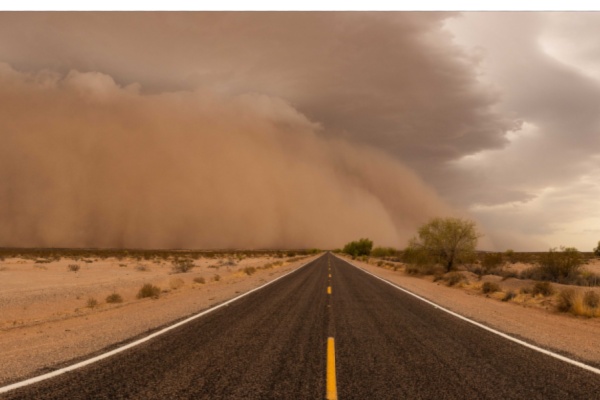
They can seem to appear from nowhere, swirling and pulsing as they grow to cover the horizon, reducing visibility to zero as they swallow freeways, streets and entire neighborhoods. They are haboobs, the huge clouds of dust that develop ahead of a thunderstorm during the Arizona monsoon.
As AZcentral reports, a powerful dust storm rolled through Phoenix on Monday, cloaking parts of the city in darkness and causing severe rain and damaging thunderstorms. Flights were grounded, widespread power outages were reported, and downed trees and wind damage also occurred across the area.
The National Weather Service issued dust storm and severe thunderstorm warnings in Phoenix as the haboob slammed into Maricopa County on Monday evening. Warning of low visibility, the NWS urged drivers to “pull aside stay alive” to avoid commuting in dangerous conditions.
“There’s been situations where the winds haven’t had to be too strong to get some blowing dust,” Isaac Smith, a meteorologist for the National Weather Service Phoenix, said in an interview earlier this year. “We could certainly be looking at potential for some more dust, so we’ll be monitoring that.”
Here’s what you need to know about haboobs and their potential threat to health and safety:
What is a Haboob?
Haboob is an Arabic word for a violent dust or sandstorm. They form when cold downdrafts from thunderstorms slam into the hot desert floor, spreading out in all directions. This rush of air can stir up large amounts of dust, lifting it into the air and pushing it forward as a wall that can stretch for miles and reach several thousand feet tall. A looming haboob is often the first visible sign that a monsoon storm is approaching, driven by powerful outflow winds rushing ahead of a thunderstorm.
What’s the difference between a Haboob and a Dust Storm?
A haboob is a specific type of dust storm that forms when strong, collapsing thunderstorm winds stir up loose dust and dirt, creating a massive, towering wall of debris that moves across the landscape. A dust storm is the broader term for any storm where strong winds lift and carry significant amounts of dust and soil into the air. Basically, all haboobs are dust storms, but not all dust storms are haboobs.
How Big can a Haboob Get?
A wall of dust ahead of a thunderstorm can reach thousands of feet into the air and span miles in width. They can carry tons of dust and other debris. On July 5, 2011, a dust storm grew to 100 miles wide and more than 1 mile high, and dumped 40,000 tons of dust on Phoenix in just two hours. Clean up took days.
Where do Haboobs usually Develop?
A haboob commonly occurs in areas that are flat and arid, which makes the American southwest a prime target. Other regions that frequently get haboobs are northern Africa and parts of the Middle East. The winds pick up dust and debris as the storm moves. Depending on conditions, the storm can appear as a huge wall of dust or as a wide series of clouds.
As the storms move from the arid desert terrain into an urban area, the haboob can appear to collapse, depositing the dust and debris it has picked up across the city. The largest storms can travel for miles, but smaller storms begin to dissipate sooner. Rain can also clear the dust from the sky.
Does it Always Rain after a Haboob?
Haboobs signal that monsoon dynamics are active, but they don’t guarantee rain will fall. A monsoon is notoriously difficult to predict. Meteorologists often don’t know how active a season will be until it begins, sometimes even later. And when rain falls, it can be spotty, drenching one part of the area, leaving another virtually dry.
While dust storms typically occur during the monsoon season, which is from June to September, they can happen any time of the year.
How to Stay Safe When a Haboob Hits
Driving during a haboob can be extremely dangerous. In 2023, Arizona recorded 106 crashes attributed to blowing sand, soil or dirt.
“The best thing to do is just don’t drive into them,” said Kelsey Mo, a spokesperson for the Arizona Department of Transportation. “Visibility can drop to zero pretty quickly, and that can leave you and others driving blind. It makes for a very dangerous situation.”
Launched by the Arizona Department of Transportation, the “Pull Aside. Stay Alive” campaign aims to provide drivers with safety and survival tips, should they ever be in a vehicle when a dust storm is approaching.
If you encounter a dust storm while driving, Mo suggests the following:
- If driving on the freeway, exit if possible.
- Check traffic around your vehicle and begin slowing down.
- Pull off the roadway as far as possible.
- Turn off all vehicle lights, including emergency flashers.
- Set the emergency brake and take your foot off the brake pedal.
- Stay in your vehicle with your seatbelt fastened and wait for the storm to pass.
“You don’t want vehicles approaching from behind to use your lights as a guide and possibly crash into your parked vehicle,” Mo said.
Drivers can stay updated by checking alerts from the National Weather Service and traffic alerts from ADOT. If you see a storm forming in the distance, Mo said it’s better to wait it out than take unnecessary risks.
—
Photo Credit: KevinRimcoski / Shutterstock.com