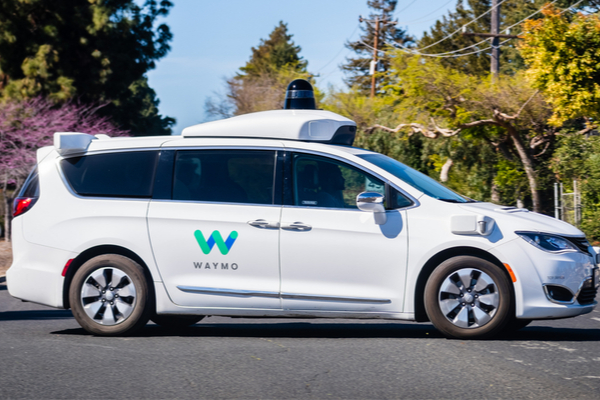
Self-driving cars are slowly becoming less sci-fi and more real-world as companies like Waymo, the autonomous arm of Google’s parent, Alphabet, expand into more areas. On Wednesday, Waymo said it’s driving in four new cities: Baltimore, Pittsburgh, St. Louis and Philadelphia.
As CNET reports, Waymo is starting with manual driving in Baltimore, Pittsburgh and St. Louis before eventually switching to autonomous operations. In Philadelphia, it’s now operating autonomously with a human specialist monitoring behind the wheel. This comes after Waymo said in July that it was bringing a limited fleet of its vehicles to “the most complex parts” of the city, “including downtown and freeways.”
Waymo currently offers fully autonomous rides to the general public in Phoenix, San Francisco, Los Angeles, Atlanta, and Austin, Texas, through the all-electric Jaguar I-Pace. The vehicles can be summoned either via the Waymo app or Uber, depending on the city.
Currently, everyday riders can’t take a Waymo vehicle on highways and freeways, but that may soon change. The company is testing fully autonomous rides on freeways in Phoenix, as seen in an exclusive video shared with CNET in May 2024. It’s also now making fully autonomous freeway rides available to Waymo employees in Los Angeles and the San Francisco Bay Area.
Growing and Adding Several New Cities
The self-driving company has added several new cities to its roster in recent months. In an Aug. 29 blog post, Waymo noted it’s “entering a new chapter and accelerating our commercial expansion.” Currently, Waymo has plans to expand to Baltimore, St. Louis, New Orleans, Minneapolis, Las Vegas, San Diego, Nashville, Denver, Seattle, Houston, San Antonio, Dallas, New York City, Philadelphia, Pittsburgh, Washington DC, Orlando, Tampa, Miami, and in its first foray across oceans, London and Tokyo are coming soon.
Waymo’s growth extends to its manufacturing facilities. In May, the company said it’s opening a new, 239,000-square-foot autonomous vehicle factory in the Phoenix area. The plan is to add 2,000 more fully autonomous Jaguar I-Pace vehicles to its existing 1,500-vehicle fleet. Notably, Waymo indicated it received its “final delivery from Jaguar” earlier this year, as it plans for future iterations of its driverless rides. Waymo added that the “facility’s flexible design” will allow it to integrate its upcoming sixth-generation self-driving technology into new vehicles, starting with the all-electric Zeekr RT.
Planning to Share its Technology with New Partners
In August 2024, Waymo unveiled the sixth generation of its self-driving technology, which strives to expand the capabilities of its driverless fleet. Smarter sensors are meant to help the cars better navigate in extreme weather, Waymo said. The sixth-gen Driver will come aboard the all-electric Zeekr vehicle, which features a flat floor, more head- and legroom, adjustable seats and a removable steering wheel and pedals. The updated tech is still being tested, but the company says it’ll be available to riders soon.
In October, Waymo also announced a partnership with Hyundai to integrate its sixth-generation Driver into the all-electric Ioniq 5 SUV, which, according to a blog post, “will be added to the Waymo One fleet over time.” The companies added that they “plan to produce a fleet of Ioniq 5s equipped with Waymo’s technology in significant volume over multiple years to support Waymo One’s growing scale.” Testing with these vehicles will start by late 2025 and become available “in the years to follow.”
Waymo is working to expand its autonomous driving tech into trucking as well, but it said in 2023 that it’s scaling back those efforts for the time being, to focus on ride-hailing with Waymo One. It noted, “Our ongoing investment in advancing Waymo Driver capabilities, especially on freeways, will directly translate to trucking and benefit its development efforts.”
Some Pushback over Safety Concerns
The self-driving company says it’s driven over 100 million fully autonomous miles on public roads and has provided more than 10 million paid rides.
That’s not to say there hasn’t been pushback as Waymo rolls out to more cities. The company’s vehicles have been involved in a handful of high-profile collisions, including one with a bicyclist in San Francisco and another with a towed pickup truck in Phoenix. (Waymo recalled and updated its software to address the issue.)
Waymo’s Safety Impact report notes that over the course of 71 million autonomous miles driven through March 2025, its Waymo Driver technology had 88% fewer crashes leading to serious injuries or worse and 78% fewer injury-causing crashes, compared with “an average human driver over the same distance in our operating cities.” It also reported significantly fewer crashes with injuries to pedestrians (93%), cyclists (81%) and motorcyclists (86%).
—
Photo Credit: Sundry Photography / Shutterstock.com