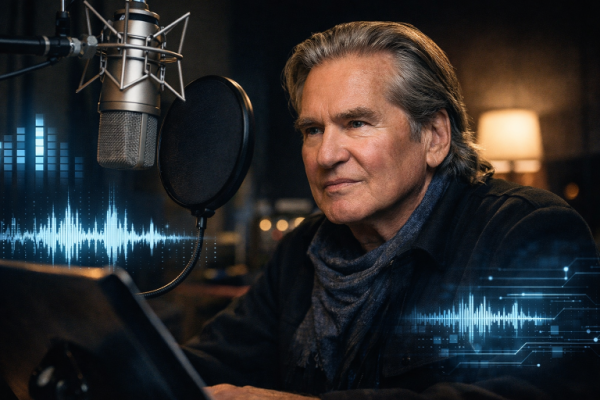
Val Kilmer’s return to the spotlight is being shaped not by a traditional comeback, but by a technological breakthrough that is redefining performance in Hollywood.
After losing much of his ability to speak following treatment for throat cancer, Kilmer has found a new voice through artificial intelligence. By using archived audio from his decades-long career, engineers have created a digital model that replicates the actor’s distinctive tone with striking accuracy.
This innovation allows Kilmer to communicate more naturally and opens the door for renewed participation in film and media projects. For an actor whose voice once carried as much presence as his on-screen performances, the development marks a significant step toward reclaiming a key part of his identity.
The technology does more than assist with communication. It signals a shift in how the film industry approaches performance and preservation. With AI now capable of reconstructing voices and potentially other aspects of an actor’s presence, filmmakers are exploring new ways to extend careers and revisit legacies.
At the same time, the advancement introduces complex questions. As digital tools become more sophisticated, the line between authentic performance and technological enhancement grows less clear. Industry professionals and audiences alike are beginning to consider what it means for an actor’s work to remain truly their own.
Kilmer’s case stands at the intersection of resilience and innovation. While the technology offers him renewed creative opportunities, it also serves as a glimpse into a future where artificial intelligence plays an increasingly central role in storytelling.
