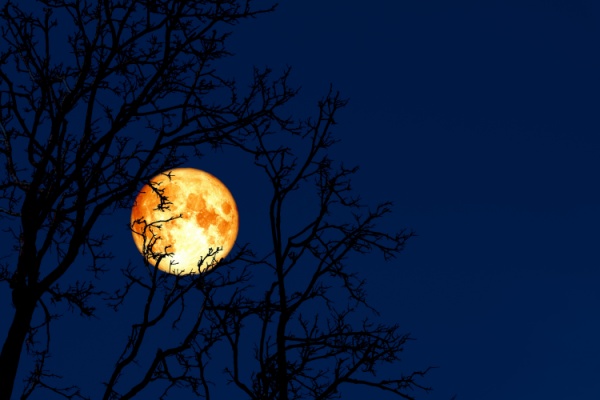
The Full Worm Moon reaches its peak on the morning of Tuesday, March 3, 2026, at 6:38 A.M. ET, and this year’s March Moon is especially notable because it coincides with a total lunar eclipse.
You don’t need any special equipment to enjoy this celestial pairing. Simply step outside and watch as the Full Moon changes color over several hours. For a detailed explanation of what’s happening in the sky, see our guide to what happens during a total lunar eclipse.
A Rare Bonus: A Total Lunar Eclipse During March’s Full Moon
As The Old Farmer’s Almanac reports, the eclipse reaches its greatest point at 6:33 A.M. ET—just minutes earlier—and during totality, the Moon can take on a coppery red or orange glow.
During a total lunar eclipse, Earth’s shadow gradually moves across the Full Moon, causing it to darken and take on a warm, coppery glow—often called a Blood Moon. This color change happens slowly and can be safely watched with the naked eye.
When Best to View the Worm Moon
This lunar eclipse will be visible across much of North America, though what viewers see will vary by location. The Moon enters the penumbra at 3:44 A.M. EST (12:44 A.M. PST) and the umbra at 4:50 A.M. EST (1:50 A.M. PST).
Totality—when the Moon is fully within Earth’s shadow—lasts from 6:04 A.M. to 7:02 A.M. EST, with the greatest eclipse occurring at 6:33 A.M. EST. In eastern regions, totality occurs close to sunrise, while observers farther west will see the eclipse higher in the pre-dawn sky.
If clouds interfere, try early Tuesday morning again before sunrise, keeping in mind that totality occurs near sunrise in eastern locations.
Moonbows and Moon Illusions are Possible
If conditions are just right and there’s a bit of mist or rain in the air, you may even spot a rare phenomenon called a moonbow—a rainbow created by moonlight instead of sunlight. Moonbows are most likely when the Full Moon is low in the sky.
This March Moon may also appear especially large near the horizon due to the Moon illusion, which makes the Moon seem bigger when it’s close to buildings, trees, or hills.
Why Is It Called the Worm Moon?
The Full Moon names used by The Old Farmer’s Almanac come from a mix of Native American, Colonial American, and European sources. Traditionally, each name applied to the entire lunar month in which the Full Moon occurred—not just the night it was full.
March’s Full Moon has long marked a turning point in the seasonal calendar, when winter begins to loosen its grip and signs of spring slowly return. The name refers to the earthworms that appear in the soil as it warms, or, according to some Native American traditions, the beetle larvae emerging from tree bark.
Other names include chaste moon, death moon, crust moon and sap or sugar moon, marking the tapping of the maple trees.
—
Photo Credit: Darkfoxelixir / Shutterstock.com