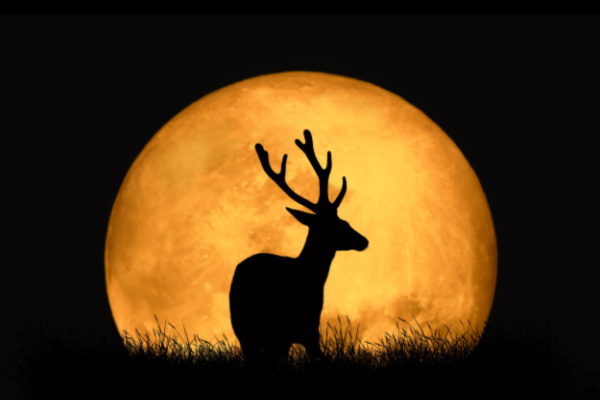
This week, July’s full Buck Moon will adorn the night sky and glow above the horizon on Wednesday, July 29, just as two annual meteor showers — Delta Aquariid and Alpha Capricornid — approach peak activity, setting the stage for several nights of cosmic events.
Why is it called the buck moon?
The Old Farmer’s Almanac, which began publishing Native American full moon names in the 1930s, states that July’s full moon is traditionally called the buck moon because male deer, or bucks, typically begin growing new antlers around this time of year. Their new antlers emerge covered in a layer of velvety fur.
Other Indigenous groups have their own names associated with July’s full moon, according to the Old Farmer’s Almanac, including the Cree’s Feather Moulting Moon and the Tlingit’s Salmon Moon, reflecting seasonal changes such as birds molting their feathers and salmon returning to the area.
When can you see the full buck moon?
As PEOPLE magazine reports, the full moon will reach peak illumination in the United States on Wednesday, July 29, at 10:36 a.m. EDT, according to the U.S. Naval Observatory’s Astronomical Applications Department. At this point, you need to look toward the eastern horizon from a location with as few buildings, trees or other obstructions as possible.
Given that the moon will be positioned close to the horizon, it could initially appear deep orange or golden, which is a result of its light traveling through more of Earth’s atmosphere. However, as it climbs higher, it will gradually return to its usual pale glow.
This year’s Buck Moon also happens to occur between two major astronomical events, rising two weeks before the total solar eclipse on Aug. 12, which coincides with the annual Perseid meteor shower, and approximately one month before the Sturgeon Moon and a partial lunar eclipse on Aug. 28.
When will the Meteors be Visible?
The Delta Aquariid and Alpha Capricornid meteor showers will reach their peak around the nights following the full moon, with peak activity expected overnight from Thursday, July 30 into Friday, July 31 and continuing into Saturday, Aug. 1.
According to the American Meteor Society, the Delta Aquariids can produce approximately 25 meteors per hour under favorable conditions, while the Alpha Capricornids typically produce around five per hour. While the latter shower may be less active, it’s known for occasionally producing especially bright fireballs.
Keep in mind that bright moonlight can make the faintest meteors more difficult to see, but it won’t put a total damper on the show.
How to Watch the Buck Moonrise Followed by the Meteors
Choose a spot with a clear view of the sky and try to arrive before sunset so you have time to get situated. As always, elevated areas, open fields, beaches and waterfront locations can offer especially unobstructed views.
No telescope is necessary — the full moon can be seen with the naked eye, although binoculars can help reveal its craters and textured surface once it rises higher.
To search for meteors afterward, turn away from the moon and place a building, tree or other large object between yourself and the moonlight if possible. Avoid looking at your phone, and allow approximately half an hour for your eyes to adjust to the darkness before you start scanning.
Although the meteor count could be reduced by the bright moonlight, one well-timed fireball could still make a late-night viewing session worthwhile.
In what Zodiac Sign does the Buck Moon Fall This Year?
The zodiac sign of each full moon is determined by the moon’s position in the night sky relative to the astrological wheel. As the moon shifts from year to year, so do the energies and themes associated with each full moon, according to Thomas.
This year, the buck moon falls in Aquarius, the 11th sign of the zodiac and the polarity of Leo. “This Air sign’s energy will be infused into our lives,” Thomas said. “This means that both zodiac signs hold ties to our passions, sense of expression, aspirations, and how we connect to others, whether that is in love or friendship.”
“Be aware that we are officially in eclipse season — so news from the lunar eclipse a month from now could actually be popping up quite early,” he added.
Rituals and Manifestations to try during the Buck Moon
Many ancient cultures and spiritual traditions have long honored celestial cycles, often harnessing the energy of the full moon for personal growth and transformation. Astrologers say the full moon can be an ideal time to manifest your dreams, set intentions and reflect on what you hope to bring into your life.
Because Aquarius is an air sign, Thomas said, speaking mantras aloud, writing down your intentions or finding another way to articulate your thoughts and desires to the universe can be especially helpful during this full moon.
—
Photo Credit: Volodymyr Burdiak / Shutterstock.com
