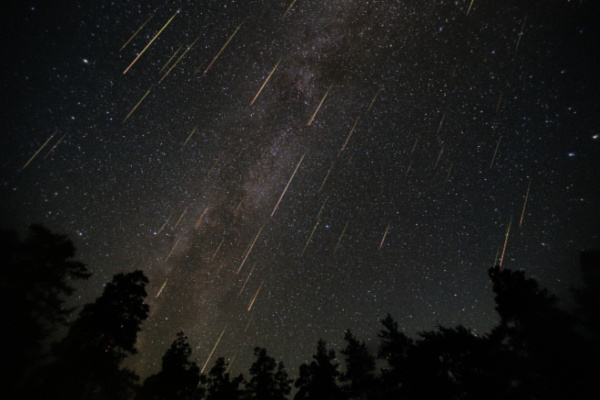
There will be plenty for stargazers to look for throughout August. This week the night skies show off with the return of the popular Perseid meteor shower and a planetary alignment.
Jupiter-Venus Conjunction: Aug. 12 before daybreak
Two of the brightest planets in the night sky will shine side-by-side on Tuesday, Aug. 12, during an astronomical event known as a conjunction. The pre-dawn event does not require a telescope, just a clear view of the eastern sky.
The planetary pair will rise after 3 a.m., local time, but will be best seen between 4 a.m. and 5 a.m., appearing about as far apart as the width of a pinky finger held at arm’s length.
Those who miss the early morning show can still catch a similar view the following morning, as Venus and Jupiter will remain tight-knit in the sky.
Perseid Meteor Shower: Aug. 12-13
The Perseid meteor shower is often touted as the best meteor shower of the year, in part due to the warm stargazing weather. This year, it will peak on the night of Tuesday, Aug. 12, into the early morning of Wednesday, Aug. 13, but moonlight from the remainder of the bright Sturgeon full moon will prevent it from reaching its full potential.
“In 2025, the waning gibbous moon will severely compromise this shower at the time of maximum activity. Such conditions will reduce activity by at least 75 percent as only the brighter meteors will be visible,” the American Meteor Society explained on its website.
This means that instead of people counting 60 to 100 shooting stars per hour, they might only count between 10 and 20 per hour.
Experts recommend focusing on darker areas of the sky where the bright moon is out of sight for the best chance at spotting some meteors. Shooting stars may start to streak through the sky not long after nightfall, but the best part of the celestial light show is expected later in the night.
—
Photo Credit: Makarov Konstantin / Shutterstock.com