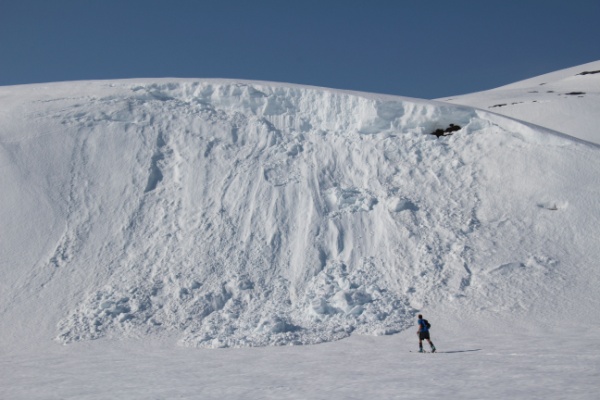
Crews have now recovered the bodies of all nine backcountry skiers who were killed in an avalanche in Northern California over President’s Day weekend.
As NPR reports, it marks an end to what authorities on Saturday described as an agonizing five-day search and recovery operation complicated by intense winter storms northwest of Lake Tahoe. “While we wish we could have saved them all, we are grateful that we can bring them home,” said Nevada County Sheriff Shannan Moon during a Saturday news conference.
Until Saturday, authorities had not confirmed the death of a ninth victim, a skier who had been missing and presumed dead. Officials say their body was found near the eight other victims that have now been recovered. Authorities said avalanche hazards and weather conditions were too dangerous most of the week to search for the remaining victim or recover the bodies.
Four of the bodies were recovered on Friday, and the rest of the bodies were recovered on Saturday, all in the Castle Peak area where the avalanche – one of the deadliest in California history — struck. Six people from the group of 15 skiers survived Tuesday’s disaster, the last day of a three-day backcountry ski trip. One guide and five travelers were among the survivors.
Helicopters with the California National Guard as well as the California Highway Patrol were used to hoist the remaining bodies from the mountain, officials said at the press conference. On Friday, officials were able to use specialized techniques with the help of Pacific Gas & Electric to reduce the avalanche risk.
What Causes an Avalanche?
As reported by The Conversation, according to Nathalie Vriend, a skier and physicist at the University of Colorado Boulder who studies avalanches, the behavior of an avalanche depends on the structure of the snowpack, but that’s only one ingredient. An avalanche requires all the wrong conditions at the wrong time.
The angle of the mountain slope is important. Slopes between 25 and 40 degrees run the greatest risk of avalanches. Those are also ideal for skiing, of course. If the slope is less than 25 degrees, there might be little slips, but the snow won’t pick up speed. If it’s over 40 degrees, the snow typically cannot accumulate, clearing away the avalanche risk.
A snowpack may be seemingly stable until a snowmobile or skier disturbs it enough that the snow starts to move. Strong winds or rock falls may also cause an avalanche. Blowing snow can create wind loading and build up into cornices, creating an overhang that can eventually fall and trigger an avalanche below.
What Happens Inside the Snowpack During an Avalanche?
According to Vriend, mountain snowpack isn’t uniform. Because it builds up over time, it is a snapshot of recent weather conditions and has both stable and weak layers. When snow falls, it’s a fluffy crystal structure. But when the temperature rises and the snow starts to melt and then refreezes, it turns more granular.
That granular, icier snow is a weak layer. When a new snowfall dumps on top of it, the grains in the weak layer can shear, creating a surface for an avalanche to slide on. The weight of new snowpack can cause the entire face of a mountain to fall away almost instantaneously. As the avalanche picks up speed, more snow and debris are incorporated in the avalanche, and it can become really big and violent.
In a real avalanche, those violent collisions create a lot of heat through friction, which causes more melting. As the avalanche comes to a rest, this liquid can quickly refreeze again, locking the snowpack in place like concrete.
Between a D2 and D3 on Avalanche Danger Scale
Avalanche deaths are rare inside the boundaries of ski resorts, but the risk rises in the backcountry. Thirty backcountry avalanche deaths were reported in the U.S. during the 2022-23 season, 16 the following year and 22 in 2024-25.
The Sierra Avalanche Center classified the avalanche between a D2 and D3 on the avalanche danger scale. “A D2 would take down a person. A D3 would take down a house, so it was right in between those. It was described by them as a football field length of a path of the avalanche,” Sheriff Moon said on Saturday.
How Can Skiers Prepare and What to do if Caught in an Avalanche?
Even if the avalanche is small, you can’t outski or outrun it easily. The big danger is when the snow is deep — you could be buried under several feet of snow. Basically, as the avalanche slows down, new snow keeps piling on top of you. People report this as being trapped in concrete without an ability to even move a limb. It must be a very frightening experience.
According to Vriend, “people say “swim to the surface” in an avalanche, but you may not know whether the surface is up or down. If the avalanche is still moving and the granules haven’t frozen solid again, you might be able to move slightly, but it is really hard.”
Backcountry skiers carry tools that can increase their chances of survival. Your best bet, though, is your peers — particularly in the backcountry, where emergency crews will take hours to arrive.
There are a few things you can do. First, carry a transceiver, which transmits a signal identifying your location. When you are caught in an avalanche, you are transmitting a signal. Your friends can switch their transceivers to the “receiving” mode and try to locate your beacon. It’s also important to have an avalanche probe and a shovel in the backcountry for when your friends do locate your position: The snow is like concrete, and it will be hard to extract you.
Avalanche air bags can also help — James Bond used an elaborate concept of one in “The World Is Not Enough.” With modern avalanche air bags, you pull a toggle on your back, and the air bag inflates behind your head, turning you into a bigger particle. Bigger particles tend to stay at the surface, making you easier to locate.
Is the Avalanche Risk Increasing with Warming Worldwide Winter Temps?
It’s not as simple as warming temperatures mean less snow, so fewer avalanches. Instead, if mountains have more variation in temperatures, they may have more melting and refreezing phases during the winter, creating weaker snowpacks compared with historical records.
The historical conditions that communities have grown up around can change. In 2017, there was a big avalanche in Italy that took out an entire hotel. It was in an area where people didn’t expect an avalanche, based on historical data.
There are computer models that can calculate where avalanches are likely to occur. But when temperatures, snowfall and precipitation patterns change, you may not be able to truly understand cause and effect on natural hazards like snow avalanches.
Multiple Agencies are Investigating
Multiple agencies are investigating. “We are investigating the incident to determine if there were any factors that would be considered criminal negligence,” Ashley Quadros with the Nevada County Sheriff’s Office said in an email to NPR on Sunday. “It is a standard investigation. It is too early to know if criminal charges will be applicable, as the investigation is preliminary and remains active and ongoing.”
The ski trip was organized by Blackbird Mountain Guides, an outdoor tour company based in Truckee, Calif. Moon confirmed the identities of the victims. Three guides were killed: Andrew Alissandratos, 34, from Verdi, Nev.; Michael Henry, 30, from Soda Springs, Calif.; and Nicole Choo, 42, of South Lake Tahoe, Calif. The other victims, who had signed up for the group trip, are: Carrie Atkin, 46, of Soda Springs; Lizabeth Clabaugh, 52, of Boise, Idaho; Danielle Keatley, 44, of Soda Springs and Larkspur, Calif.; Kate Morse, 45, of Soda Springs and Tiburon, Calif.; Caroline Sekar, 45, of Soda Springs and San Francisco; and Katherine Vitt, 43, of Greenbrae, Calif.
The area will be closed to visitors for several weeks.
—
Photo Credit: BriefcaseToBackback / Shutterstock.com