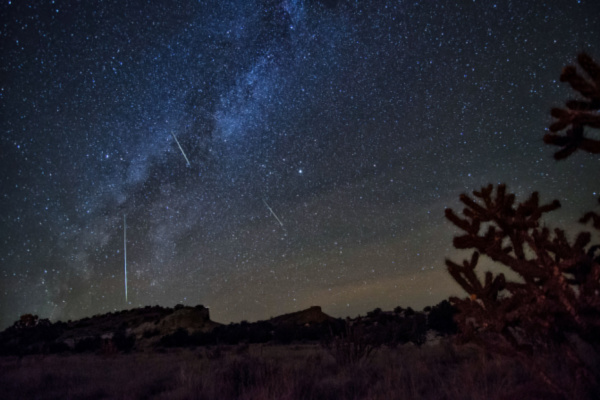
Shooting stars are now zipping through the night sky in the Orionid meteor shower, one of the most reliable meteor showers of the year, but this year it’s joined by two recently discovered comets, Lemmon and SWAN, to make it quite a spectacular show for star gazers.
As The Times reports, the peak of the Orionid meteor shower is on Wednesday, but the meteors are clearly visible for several days before and after, and this year’s display is particularly impressive because there is a new moon on Tuesday night, leaving night skies particularly dark, helping to make the meteors stand out.
The Orionid Display
Orionids are the product of Halley’s Comet, which was last seen in the inner solar system in 1986 and will next be seen in 2061. The other meteor shower caused by Halley’s Comet is April’s Eta Aquariids.
The Orionid display happens as the Earth passes through a trail of dust shed in space in the wake of Halley’s Comet — although we won’t see the comet itself until midsummer 2061. The dust fragments from the comet are only the size of a grain of sand but travel at speeds of about 41 miles per second (148,000mph, 238,000km/h) and become superheated as they zip through Earth’s upper atmosphere some 60 miles high. T
The dust fragments make gases glow as bright and fast meteors as they leave a distinctive trail of light. And the Orionids also sometimes feature larger meteors that can appear much brighter, which are known as fireballs. In this week’s display there could be about 15 meteors an hour during the peak of the meteor shower on Wednesday between midnight and dawn.
The great thing about meteors is that they can be seen with the naked eye and do not need a telescope, although it helps to get as far away from artificial lights as possible. But the biggest challenge with the Orionids shower will be the weather. Low pressure is dominating the UK, giving widespread clouds and even some fog, but the night skies late on Wednesday may offer a better chance of more widespread clear skies.
Lemmon and SWAN Comets
By coincidence, two recently discovered comets, Lemmon (known as C/2025 A6) and SWAN (C/2025 R2), also reach their brightest points in the night sky at about the same time as the Orionids. Comet SWAN makes its closest approach to Earth on Monday and the brighter Lemmon makes its closest approach on Tuesday.
As Scientific American reports, astronomers discovered the Lemmon comet in January as part of the Mount Lemmon Survey in Arizona’s Santa Catalina Mountains and calculated that it’s on a 1,350-year orbit around the sun—so if you miss it this time around, you’re out of luck. Comet Lemmon will be closest to Earth on October 21, when it passes within 55 million miles (89 million kilometers) of our planet.
According to Live Science, Comet Lemmon will be low in the northwest between the end of the handle of the Big Dipper and the bright star Arcturus. Comet SWAN, which was first spotted in September by NASA’s orbiting Solar Dynamics Observatory, will be low in the south, just below the bright star Altair, one of the three stars in the famous Summer Triangle shape.
—
Photo Credit: Brian Spencer / Shutterstock.com