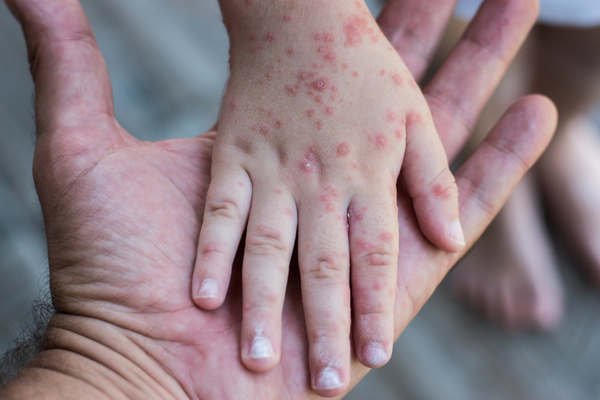
Measles cases are climbing fast in South Carolina, and health officials say the outbreak is now spreading beyond state borders.
As HealthDay News reports, the South Carolina Department of Public Health has confirmed 99 new measles cases since January 6, bringing the state’s total to 310 cases, officials said in their latest update on Friday. About 200 people who were exposed to the virus are now in quarantine.
Most cases are centered in Spartanburg County, in the northwest part of the state. “Some cases are travel-related exposures or close contacts of known cases,” the health department said. “Other cases have no identified source, suggesting that measles is circulating in the community and could spread further.”
The Spread Has Begun Across Multiple States
Unfortunately, that spread has already begun. Earlier this week, North Carolina health officials reported three siblings in Buncombe County were diagnosed with measles after visiting Spartanburg. And the spread hasn’t just shown up on the East Coast. Washington state, health officials said three people who traveled from South Carolina were later diagnosed with measles in Snohomish County.
In the Washington State cases, one of the infected was an adult who had received one dose of measles-mumps-rubella (MMR) vaccine – but possibly had never received a follow-up – and the other two were unvaccinated children. “The family visited multiple locations” while contagious, officials said, including restaurants, a church and a trampoline park.
What’s more, a separate measles outbreak along the Arizona–Utah border has reached 390 cases, including 214 in Arizona and 176 in Utah. In fact, Utah health officials have reported multiple exposures in recent weeks, including events at a high school in St. George and a drill competition near Salt Lake City.
In Ohio, three children, ages 10, 7 and 2, have been diagnosed with measles, according to state officials. A fourth child was said to be showing symptoms. “The children were all unvaccinated at the time they were exposed and traveled to an area in the United States with an ongoing measles outbreak,” the Ohio Department of Health wrote on its website.
Measles is One of the Most Contagious Viruses Known
Measles is one of the most contagious viruses known. Last year, the United States recorded 2,144 measles cases, the highest number since 1991. About 93% of cases were in people who were unvaccinated or whose vaccination status was unknown.
According to the Centers for Disease Control and Prevention (CDC), measles is a highly contagious virus that lives in the nose and throat mucus of an infected person. It can spread to others through coughing and sneezing pr even talking, and can linger for up to two hours after the infected person has left. It can also be spread by just touching surfaces with the virus and then touching your own eyes, nose, or mouth.
If you have measles, up to 90% of the people close to you, who are not immune, will also become infected. An infected person can spread measles to others even before knowing they have the disease. You can spread measles to others from 4 days before through 4 days after the rash appears.
As measles continues to spread across the U.S., with outbreaks popping up around the country, public health experts have been stressing the importance of getting vaccinated to stop the spread of disease. This has even involved local doctors and health department workers going into outbreak areas to offer free measles, mumps, and rubella (MMR) vaccines.
The Importance of the MMR Vaccine
The MMR vaccine is typically a two-dose series given first at 12-15 months old and again at 4-6 years of age. An extra dose can be given as early 6 months old in high-risk circumstances, including during a measles outbreak.
As ABC News reports, health experts working in and near measles outbreaks state that vaccine acceptance has been mixed among these communities, with some people begging to get their kids vaccinated early, while others still refuse an immunization.
“[Measles] can spread so quickly amongst that unvaccinated population,” Dr. Christopher Lombardozzi, chief medical officer at Spartanburg Regional Healthcare System, told ABC News. “And if the number of people who remain unvaccinated stays large, then we could have a real problem, not just this year, but in years to come.”
Battling Vaccine Hesitancy
Lombardozzi said the health care system has seen some increased vaccine uptake, but not as much as they hoped for. “We certainly have had some more uptake of vaccine in the last six months or so, since the outbreak started here in South Carolina, and I’m happy for that,” Lombardozzi said. “I would love to see a higher uptake. There is still quite a bit of vaccine hesitancy around here, and I think it’s unwarranted.”
Lombardozzi added that addressing vaccine hesitancy takes time and support. “We try to support people, meet them where they are, and hopefully they will change their mind if they’ve been vaccine hesitant for a while,” he said.
Lombardozzi worries that without increasing immunizations, the negative effects could ripple for years.
—
Photo Credit: pavodam / Shutterstock.com