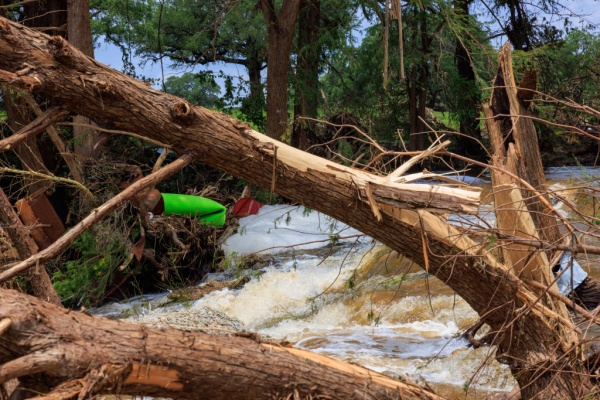
On July 4, nearly 2 feet of rain fell in and around Kerr County in central Texas, causing flooding that killed more than 120 people. On July 7, almost a foot of rain struck central North Carolina as Tropical Storm Chantal moved inland. Then on July 8, in the remote village of Ruidoso – about 180 miles south of Albuquerque – which was badly fire-scarred from last year’s South Fork fire, heavy rains caused Rio Ruidoso to rise over 19 feet in less than an hour and three people died as a result.
All are considered to be at least “1,000-year flood” events. The words “devastating” and “historic” are being used almost daily to describe flooding events that are popping up all around the country. But what does that mean, and how could we see so many events in such a short time period? The terms researchers use to rank floods and heavy rainfall are complex, nuanced, and often confusing.
What is a 1,000 Year Flood?
According to the US Geological Survey (USGS), the term “1,000-year flood” means that, statistically speaking, a flood of that magnitude (or greater) has a 1 in 1,000 chance of occurring in any given year. In terms of probability, the 1,000-year flood has a 0.1% chance of happening in any given year.
As AccuWeather reports, for home insurance purposes, a 100-year flood means that there is a 1 percent chance of that flood happening in any given year at your home’s location. A 1,000-year flood would be a 0.1 percent chance, so in 1,000 years, you’d expect 1 such flood to occur. But statistics don’t dictate when during that period the floods will occur, and the floods could happen in rapid succession without violating the rule.
These flood statistics are based on how often the nearest USGS river gauge (there are about 7,500 nationwide) would exceed a certain amount of water flowing past it, based on records at those stations that go back as far as 175 years.
According to AccuWeather, when meteorologists talk about 1,000 year floods, they are really talking about the frequency of a certain amount of rainfall at one of tens of thousands of points that have weather station records going back to the 1800s. In meteorology, this is called the “return interval.” Again, a 1,000-year rainfall return interval would be a 0.1 percent chance of rain that heavy, or something you could expect in 1,000 years. While that’s not exactly the same as the flood definition, they are often used interchangeably.
There are tens of thousands of discrete points on land for which these rainfall amounts are determined, and each has its own 1,000-year amount. There’s no reason that multiple locations in the United States couldn’t have a 1,000-year rainfall at the same time. In fact, this week, half a dozen points in Texas and North Carolina both recorded 1,000-year rainfalls.
To complicate things further, each point has different time periods that define the floods, from minutes to hours to days. So, a location could set a 100-year rainfall for 24 hours while setting a 10-year rainfall for 1 hour, at the same time. Those combinations produce millions of possible records to be broken, so it’s not unusual to see multiple records broken every day.
How Many 1,000 Year Floods Have Happened So Far in 2025?
AccuWeather reports that, looking at 24-hour time periods of rainfall return intervals, there were a dozen recorded 1,000 year flooding events over the span of just three days in early July. Colorado State University data states that there have already been thirty locations so far in the United States that have broken their 1,000-year rainfall amounts this year. There were 35 total in 2024, and we’re only just past halfway through the year.
Between 2002 and 2024, there were hundreds of 1,000-year rainfall events for a 24-hour period. For 100-year rainfall, the threshold was exceeded thousands of times in every state monitored (Washington and Oregon are missing due to missing historical data there).
The most common months to break a 24-hour return interval are the summer months — June, July and August — because that’s when the heaviest thunderstorms happen. September and October are also big months because of tropical storms and hurricanes.
Sorry, but Yes, it’s Because of Climate Change
Colorado State’s tracking doesn’t go back far enough to call it with absolute certainty, but ClimateCentral‘s data shows that climate change is making flooding events dramatically worse than they would otherwise be.
In Austin, located in the central Texas region, they report that rainfall intensity has increased by 19% between 1970 and 2024. In New Mexico, the Rio Riudoso ultimately crested at a record-breaking 20.24 feet — 5 feet higher than the previous record from last year of 15.86 feet, and in fact, the river gauge spike was “the highest since data began in 1978,” AccuWeather meteorologist Jesses Ferrell noted.
Annually increasing global and local temperatures lead to increased evaporation, resulting in a more moisture-laden atmosphere. This excess moisture, when released as precipitation, usually results in heavier rainfall and more intense flooding. Furthermore, climate change can alter weather patterns, leading to more frequent and intense storms and contributing to the increased risk of flooding. For example, studies have shown that human-caused climate change has intensified rainfall in some recent hurricanes, leading to more devastating flooding.
Here’s a more detailed breakdown:
- Increased Evaporation and Moisture: As the planet warms, more water evaporates from oceans and land surfaces, increasing the amount of moisture in the atmosphere. For every 1 degree Celsius increase in temperature, the atmosphere can hold approximately 7% more water vapor, according to the Environmental Defense Fund.
- Heavier Rainfall: This increased atmospheric moisture translates to more intense rainfall when conditions trigger precipitation, leading to more severe flooding events.
- Altered Weather Patterns: Climate change can disrupt weather patterns, potentially leading to more frequent and intense storms, as well as changes in rainfall distribution, both of which can increase flood risks.
- Vulnerable Infrastructure: Existing flood control infrastructure, such as dams and levees, may not be adequate to handle the increased intensity and frequency of flooding events predicted under climate change. Many systems are already in need of repair and upgrades, and the added stress of climate change can exacerbate the problem.
- Impacts on Communities: Flooding can cause significant damage to infrastructure, disrupt communities, displace populations, and have devastating economic consequences. In addition to physical damage, flooding can also lead to water contamination and other public health issues.
—
Photo Credit: Karim Shuaib II / Shutterstock.com