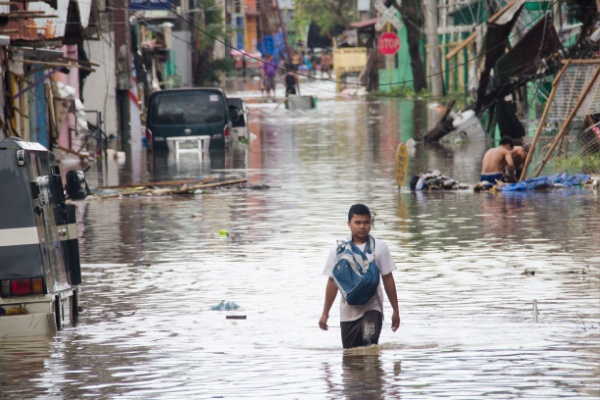
A super typhoon has struck in East Asia, leaving a massive trail of destruction in its wake and resulting in at least 17 deaths.
As PEOPLE reports, on Tuesday, Sept. 23, Super Typhoon Ragasa struck the Philippines and southern Taiwan, before hitting Hong Kong on Wednesday. The typhoon spanned 100 kilometers (62 miles) south of the city, triggering a No 10 storm warning (T10), the BBC and South China Morning Post reported.
The Fullerton Ocean Park Hotel in the coastal area of Aberdeen, Hong Kong found itself embroiled in the storm as typhoon waves crashed into the lobby around 6:00 a.m. local time on Wednesday, the Hong Kong outlet The Standard reported.
In shocking footage posted on Facebook, large waves are seen breaking through the glass doors of the lobby as water rushes in and quickly floods the hotel. One person gets swept up in the water while others clamber to the sides of the area as screams are heard in the background.
No one was injured in the incident, The Standard reported. The Fullerton Ocean Park Hotel posted on its website that the hotel shuttle is continuing to operate between Ocean Park Station Exit B and the hotel “while Gale or Storm Signal No.8 is hoisted.”
17 Dead Reported in Taiwan
As of Wednesday morning, 17 people have been reported killed in the floods in Taiwan as a result of the Matai’an Creek barrier lake bursting, the BBC reported, citing Taiwanese authorities. Around 90 people are reportedly injured with many missing. Taiwanese Premier Cho Jung-tai said in a statement on Facebook that “disaster relief and recovery, top priority now.”
“President yesterday instructed the national army to make full effort to rescue, the central government has set up a ‘forward coordination office’ to move in,” he said. “We will also fully dispatch engineering, medical staff and supplies, social workers and other personnel to get through difficulties with the villagers.”
Ragasa’s Path of Destruction
Ragasa first made landfall as a super typhoon in the Philippines on Monday, Sept. 22, with sustained wind speeds of over 165 mph, the equivalent to a Category 5 hurricane. Thousands of people were displaced in the Philippines due to the storm, according to the AP.
Ragasa is considered one of the most powerful storms on Earth in 2025. Schools and businesses closed and hundreds of flights were canceled in southern China and Hong Kong ahead of the storm, according to the Associated Press (AP) and BBC. Chinese state broadcaster CCTV said more than 770,000 people were evacuated from Guangdong and that one million people are expected to be relocated across the province, Reuters reported.
The Hong Kong Observatory (HKO) reportedly said water levels could reach between 12 and 15 feet in some areas as the storm passes through. HKO issued a T10 signal at 2:40 a.m. local time on Wednesday. The signal was lowered to T8 at 1:20 p.m., before decreasing to a T3 signal, per the Morning Post.
Typhoon Ragasa is expected to hit Vietnam and Laos on Thursday, per the BBC.
What Makes Ragasa a Super Typhoon?
According to Britannica, the terms typhoon and hurricane are regional names for the same weather phenomenon, the tropical cyclone. Tropical cyclones are intense circular storms that begin over warm tropical oceans, and they are characterized by low atmospheric pressure, high winds, and heavy rain. They draw their energy from the sea surface, so they can retain their strength as long as they remain over warm water. Tropical cyclones generate winds that exceed 119 km (74 miles) per hour. Indeed, the strongest ones produce sustained winds in excess of 240 km (150 miles) per hour and gusts surpassing 320 km (200 miles) per hour.
The term super typhoon is used when a typhoon’s sustained surface-wind strength reaches 240 km (150 miles) per hour, the equivalent of a strong category 4 or category 5 hurricane. Some weather bureaus, such as the Hong Kong Observatory (which classifies super typhoons as storms with sustained wind speeds of 185 km [about 115 miles] per hour) and the Japanese Meteorological Agency (which classifies violent typhoons as storms with sustained wind speeds of 194 km [about 120 miles] per hour) have lower thresholds.
—
Photo Credit: at.rma / Shutterstock.com