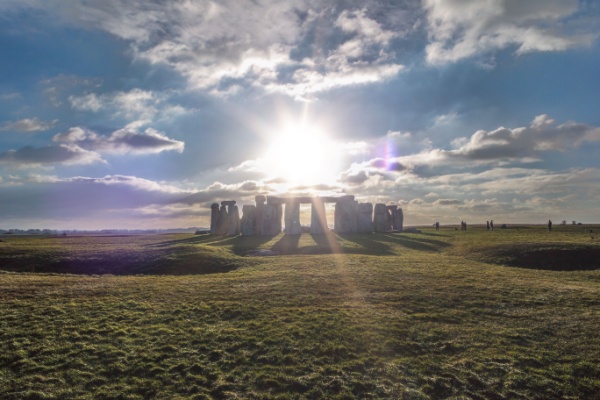
A solstice lasts only a moment, when the sun is at its farthest north in our sky for an entire year. Yet many will celebrate this solstice for a whole day. What is a solstice? And what makes this day so special?
What is Summer Solstice?
According to EarthSky, at the June solstice, the sun reaches its northernmost point. This point is on the celestial Tropic of Cancer, a parallel around the sky, 23.5 degrees north of the celestial equator. At this solstice, the Northern Hemisphere is most tilted toward the sun, by the maximum angle of 23 1/2 degrees. Conversely, the south is most tilted away, by the same amount.
At the June solstice, no matter where you are on Earth, the sun rises and sets farthest north on your horizon. The sun is directly overhead at local noon as viewed from the Tropic of Cancer. Throughout the Northern Hemisphere, the sun is high in the sky and closest to being overhead at local noon.
For us in the Northern Hemisphere, the June solstice marks the shortest nights and longest days of the year. For the Southern Hemisphere, however, it marks the longest nights and shortest days. After this solstice, the sun will begin moving southward in our sky again.
Solstice has been here since Time Began
Ancient cultures knew that the sun’s path across the sky, the length of daylight and the location of the sunrise and sunset all shifted in a regular way throughout the year. With this in mind, they built monuments such as the ones at Stonehenge in England and at Machu Picchu in Peru to follow the sun’s yearly progress.
For us in the modern world, the solstice is a time to recall the reverence and understanding that early people had for the sky. Some 5,000 years ago, people placed huge stones in a circle on a broad plain in what’s now England and aligned them with the June solstice sunrise.
We may never comprehend the full significance of Stonehenge. But we do know that knowledge of this sort wasn’t limited to just one part of the world. In fact, around the same time Stonehenge was being constructed in England, two great pyramids and then the Sphinx were built on Egyptian sands. If you stood at the Sphinx on the summer solstice and gazed toward the two pyramids, you’d see the sun set exactly between them.
As EarthSky reports, today, we know that the solstice is caused by Earth’s tilt on its axis and by its orbital motion around the sun. The Earth doesn’t orbit upright with respect to the plane of our orbit around the sun. Instead, our world is tilted on its axis by 23 1/2 degrees. Through the year, this tilt causes Earth’s Northern and Southern Hemispheres to trade places in receiving the sun’s light and warmth most directly.
So it’s Earth’s tilt – not our distance from the sun – that causes winter and summer. In fact, our planet is closest to the sun in January, and farthest from the sun in July, during the Northern Hemisphere summer.
Signs of the June Solstice in Nature
Where should you look to see signs of the solstice? Everywhere. For all of Earth’s creatures, nothing is so fundamental as the length of the day. After all, the sun is the ultimate source of almost all light and warmth on Earth’s surface.
EarthSky says that if you live in the Northern Hemisphere, you might notice the early dawns and late sunsets, and the high arc of the sun across the sky each day. You might see how high the sun appears in the sky at local noon. And, also be sure to look at your noontime shadow. Around the time of the solstice, it’s your shortest noontime shadow of the year.
If you’re a person who’s tuned in to the out-of-doors, you know the peaceful, comforting feeling that accompanies these signs and signals of the year’s longest day.
Is the June Solstice the First Day of Summer?
No world body has designated an official day to start each new season, and different schools of thought or traditions define the seasons in different ways. In meteorology, for example, summer begins on June 1. And every schoolchild knows that summer starts when the last school bell of the year rings.
Yet June 21 is perhaps the most widely recognized day upon which summer begins in the Northern Hemisphere and upon which winter begins on the southern half of Earth’s globe. However, the June solstice can fall on June 20 or 22. Indeed, there’s nothing official about it, but it’s such a long-held tradition that we all recognize those dates as the June solstice.
Lag of the Seasons
Even though the Summer solstice is when we experience the longest day of the year, it is not the hottest. This effect is called the lag of the seasons. It’s the same reason it’s hotter in midafternoon than at noontime. Essentially, just as it takes a moment or two for the water coming out of your faucet to heat up, Earth just takes a while to warm up after a long winter. Even in June, ice and snow still blanket the ground in some places. The sun has to melt the ice – and warm the oceans – and then we feel the most sweltering summer heat.
Ice and snow have been melting since spring began. Meltwater and rainwater have been percolating down through snow on tops of glaciers. However, the runoff from glaciers isn’t as great now as it’ll be in another month, even though sunlight is striking the Northern Hemisphere most directly around now.
So wait another month for the hottest weather. It’ll come when the days are already beginning to shorten again, as Earth continues to move in orbit around the sun, bringing us closer to another winter.
And so the cycle continues.
—
Photo Credit: Lukassek / Shutterstock.com