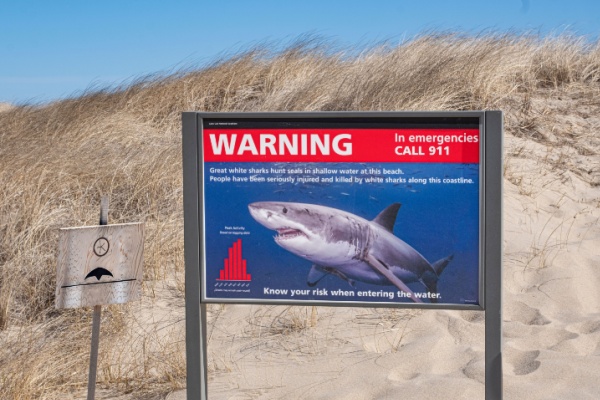
On July 4, a shark attack occurred off the coast of Long Island, already marking the third unprovoked U.S. attack for 2025.
Luckily, the incident only resulted in minor injuries to the 20-year-old victim. She was wading in waist deep waters at Jones Beach State Park just after 4pm when something bit her lower leg. Though she couldn’t see what was responsible for the bite, an investigation led by the Department of Environmental Conservation determined it was likely a juvenile sand tiger shark.
There’s nothing scarier than a shark in the water. It’s the stuff nightmares are made of and has served as a potent horror symbol in movies like “Jaws” (celebrating its 50th anniversary this year) and “Open Water.” Sharks may be dangerous apex predators, attacking around 100 people yearly, but their attacks are not always intentional.
Where are Shark Attacks Most Common in the U.S.?
Most shark attacks are cases of mistaken identity, freak incidents, or bite tests (how sharks explore or test organisms and objects in the water). That said, some places have more shark attacks than others.
For example, within Florida, most attacks happen in Central Florida, along the Volusia County coastline. Located along the Atlantic coastline of Florida, New Smyrna Beach has the highest shark attack rate in the world and has been dubbed the “shark bite capital of the world.” Since the early 1900s, more than 300 attacks have been reported—but the majority of reported attacks are minor.
Since 1995, the Hawaiian Islands have seen 177 shark incidents around the archipelago. Of those incidents, 64 were reported to be involving surfers. There have been nine total fatalities, and four of them were people surfing. Bethany Hamilton lost her left arm to an estimated 15-foot tiger shark in Kaua’i back in October 2003 and was in the water one month later. Most recently, accomplished surfer, professional lifeguard and occasional actor Tamayo Perry died after sustaining fatal injuries in a shark attack off the island of Oahu, near Goat Island, in Hawaii.
According to California’s Department of Fish and Wildlife, there have been 221 shark incidents in and around the waters off La Jolla, California, since 1950, of which 16 resulted in a fatality. The government body also notes that shark incidents are extremely rare along the coastline. The beach with the most shark incidents is La Jolla, with 12 documented events, all from great white sharks. Now, it is understood that sharks are being tagged to monitor the population and to get to the bottom of why so many incidents have happened in La Jolla.
Back in 2006, research efforts to understand shark incidents found that around 38 percent of great white shark events were in an area of central California, which has now become known as the Red Triangle. This area runs from Bodega Bay out into the Pacific to beyond the Farallon Islands and then down south past Big Sur.
Other parts of the world where recorded shark sitings and attacks are high:
- New South Wales, Australia
- Greater Perth, in Western Australia
- Reunion Island in the Indian Ocean
- Boa Viagem, Brazil
- Eastern Cape, South Africa
Shark Attacks are Actually Rare
No matter the motive, shark attacks can result in lost limbs or even death. Luckily, in the grand scheme of things, shark incidents are extremely rare. So rare, in fact, that despite the coverage by wider media, they’re actually one of the least likely animals to cause you any harm, especially when it comes to fatalities.
According to statistics from the International Shark Attack File, there have been just over 3,000 confirmed unprovoked shark attacks worldwide since 1958, with about 400 of these being fatal. Overall, worldwide incidents have been on a sharp decline in the past decade. In fact, since 2012, there have only been 60 shark attack fatalities, with 761 total bites, according to the International Shark Attack File (ISAF).
Bees, deer and elephants all rank higher than sharks in terms of fatal “attacks.” But none are as deadly as mosquitos, with an estimated 1,000,000 deaths per year versus the shark’s four in 2024.
However, as noted by one researcher, the climate conditions that bring people to the beach also bring sharks into shallow water.
Why it Feels Like There Are More Sharks
The perception of more sharks in the Atlantic, particularly in coastal areas, is likely due to a combination of factors including increased human activity in traditional shark habitats, shifting migratory patterns influences by warming ocean temps, and improved monitoring and reporting of shark populations.
Sharks are highly migratory species that embark on annual migrations from the northern portions of west Atlantic (the lower Northeast to Canada), then as the weather cools down in September or October they swim to their southern habitats (Carolinas down to Florida).
However, while shark encounters might seem more frequent due to increased beach activity, the primary driver of sharks venturing closer to shore is climate change-related ocean warming. This warming is causing shifts in shark migration patterns and prey distribution, leading to sharks spending more time in areas closer to human activity.
Here’s a more detailed explanation:
- Ocean Warming: Rising ocean temperatures, particularly along coastlines, are attracting certain shark species, such as juvenile white sharks, to these warmer waters.
- Changing Prey Distribution: Warmer waters can also impact the distribution of fish and other marine life that sharks prey on. This can force sharks to move closer to shore in search of food.
- Shifting Migration Patterns: Some shark species are extending their migrations further north or south, following warmer waters and altering their usual patterns.
- Increased Human Activity: The increase in human presence in the water, especially during summer, also contributes to the perception of more shark encounters.
- Conservation Efforts: Successful shark conservation efforts are leading to increased shark populations, which may also result in more frequent sightings and encounters.
- Improved Monitoring and Reporting: Marine biologists have vastly improved their tracking abilities, which may also make it seem like there are “more” sharks, when in fact, scientists just have a better ability to pinpoint them.
—
Photo Credit: Jane Karelas / Shutterstock.com