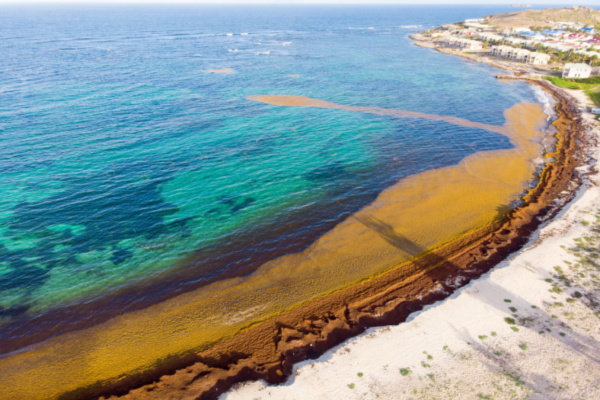
There’s nothing more disgusting while trying to enjoy a pristine, sandy beach and clear blue water than smelly piles of sargassum lining the beaches and surf. Unfortunately, this year is shaping up to be one of the worst years for sargassum on record.
As The Weather Channel reports, the University of South Florida Optical Oceanography Lab’s Sargassum Watch System (SaWS) is reporting record high levels of sargassum across parts of the Caribbean. This includes areas in the western and eastern Caribbean as well as the western Atlantic and Gulf, including some Florida beaches.
Growing to Even Higher Amounts in Coming Months across Atlantic Basin
And their projections show the sargassum growing to even higher amounts in the coming months. This is because satellite data shows larger accumulations of sargassum across the Atlantic basin, compared to historical averages. Just in the last 30 days, sargassum across the Atlantic has surged from just under a half million tons to nearly 1.7 million tons.
According to a Caribbean news outlet, there has been early accumulations on beaches in Barbados, Dominica and the French Antilles. They are also seeing high concentrations of sargassum in popular spring break spots like Tulum and Cancun beaches in Mexico.
So much so that the Mexican navy has been called in to combat the sargassum. They are deploying containment barriers and have launched amphibious collection boats that are working around the clock to retrieve and discard the sargassum, in hopes to save spring break beaches from the rotten egg smell.
What Is Sargassum?
Sargassum is a genus of large brown seaweed, which is a type of algae. It floats on the ocean’s surface in “island-like masses,” and actually has great benefits to the ocean’s ecosystem. Sargassum never attaches to the seafloor, although it does eventually lose buoyancy and sink to the bottom.
Sometimes these rafts of sargassum can stretch for miles across the ocean. They provide food, shelter and breeding grounds for species such as fish, sea turtles, birds and crabs. Sargassum can multiply when the rafts break apart and grow into new, larger ones. Since 2001 sargassum in the Atlantic has expanded into a 5,000-mile-long raft known as the “Great Atlantic Sargassum Belt.”
Rising ocean temperatures and increased nutrients in the ocean such as phosphorus and nitrogen have caused sargassum to multiply rapidly during the last decade. Ocean currents and winds are steering these large sargassum rafts onto the beautiful, pristine beaches that depend on tourism.
Should I Cancel My Spring Break Trip?
It’s important to note that just because sargassum is reported on a particular island, that doesn’t mean the entire coast of that island is covered in sargassum.
A strong offshore wind can push the sargassum just past the breakers, and leave most of the beach free and clear, whereas, a strong onshore wind can drive it onto the beaches. The leeward side of an island is usually going to have less sargassum than the windward side. And resorts are becoming experts at removing the sargassum each morning, in hopes it doesn’t ruin your vacation.
In order to salvage your vacation experience, stay on top of where the sargassum is around the area you are visiting, because sargassum shouldn’t impact the entire region. Having flexibility and being open to driving to a nearby beach that isn’t impacted could make the experience much better.
Experts believe that sargassum is most likely the new normal in the tropics, but with a little flexibility and an eye on the winds, travelers can dodge the rotten egg smell and land on a beach where the only thing floating nearby is the umbrella in your piña colada.
—
Photo Credit: Multiverse / Shutterstock.com