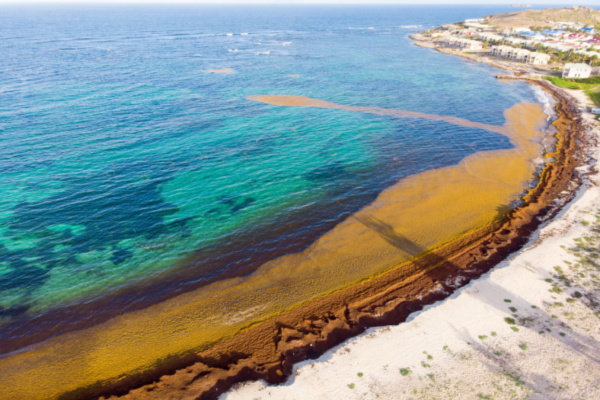
A record amount of sargassum seaweed has been washing ashore across South Florida since May, frustrating beachgoers and creating a growing challenge for coastal communities.
The brown seaweed has piled up along beaches throughout the region, leaving behind large mounds that many visitors say are affecting their beach experience, and it’s even been increasing in June.
Scientists at the University of South Florida’s Optical Oceanography Lab reported that sargassum levels reached a record high for the month of May, according to FOX Weather. Researchers estimate that at least 4% of the ocean’s surface is covered by floating mats and clusters of seaweed, with levels expected to increase further throughout June.
What is Sargassum?
“I try to shy away from the term blob. That’s not really what it is,” says Barnes, who says that the Great Atlantic Sargassum Belt is really a series of many small blobs with individual patches that are as large as an acre. Smushed together, he adds, it would be roughly the size of Delaware.
As National Geographic reports, Sargassum is a golden to reddish-hued seaweed, a large macroalgae, that’s continuously whisked atop the ocean’s currents. Unlike other types of seaweed, such as the kelp that’s anchored to the shallow ocean floor, sargassum is adapted to life on the open sea and lives solely in floating patches. Much of it can be found in the western Atlantic’s Sargasso Sea, which is such an important ocean habitat to so many marine creatures it’s been called the “golden floating rainforest.”
Because sargassum is made for life adrift, it regularly travels across the sea. The ocean is full of different currents that move across the globe like conveyor belts. The sargassum nearing U.S. beaches will have spent time off the western coast of Africa, then the high seas of the Atlantic Ocean, and finally in the Caribbean Sea, where much of the sargassum resides this time of year.
Based on currents, Barnes says, the sargassum usually enters the Gulf of Mexico, makes a U-turn, and then reenters the Atlantic Ocean, passing by southern Florida from around April to June.
Unsightly, Yes, but there’s also the Smell
While the seaweed itself can be unsightly, it’s not considered deadly or dangerous. However, many residents say the odor it produces is the biggest problem. In addition to blocking beach access, sargassum stinks.
As it decomposes it releases a gas called hydrogen sulfide that smells like rotten eggs. That gas can irritate the eyes, nose, and throat, according to the Florida Department of Health. Tiny sea creatures, like jellyfish, may also live in sargassum and can irritate skin. Health officials say the gas can irritate the eyes, nose and throat and may be especially troublesome for people with asthma and other respiratory conditions.
Residents who have discussed the issue online described the smell as one of the most unpleasant aspects of the ongoing seaweed buildup. “The smell is so noxious where I live from all the decomposing sargassum,” one Reddit user wrote. “It’s really bad.”
Others said the odor has become so recognizable that even photos of the seaweed trigger memories of it. “I can literally SMELL these photos,” another commenter wrote. Another beachgoer said the seaweed made spending time in the water less enjoyable than usual. “I was at the beach today, and honestly it was annoying,” the commenter wrote. “You can’t enjoy the water.”
Images shared online showed thick bands of seaweed stretching across portions of the shoreline. “Pictures don’t really do it justice,” one Reddit user wrote. “You had to walk through what felt like a foot of seaweed just to reach the water.”
A Rising Concern
While it serves as an important habitat for marine species, including sea turtles, crabs, shrimp and fish, unusually large blooms have become a recurring issue region-wide. Sargassum has existed for about 30 million years, but blooms of this massive size are a rising concern. “To our best knowledge, 2011 was the first year that there was a big bloom of this stuff,” says Barnes.
According to National Geographic, dangerous algal blooms like red tides can be fueled by pollution, and sargassum is no different. When farmers spray fertilizers on land, they release chemicals laden with nutrients to help crops grow. When those fertilizers leak into rivers and make their way out to sea, they release the same plant-growing nutrients onto sea plants, unintentionally giving them a boost. In the past decade, one culprit has been the Amazon River, says Cynthia Heil, the director of the Mote Marine Laboratory and Aquarium’s Red Tide Institute.
When that excess sargassum piles up on beaches, it’s—at best—a nuisance for businesses that rely on tourists flocking to clean, seaweed-free beaches. After a large sargassum bloom in 2018, occupancy rates at Riviera Maya hotels along the Yucatan Peninsula dropped. This year, that same shoreline is bracing for record levels again.
The seaweed, in excess, can also harm the ecosystem. The thick, tangled mass can smother coral reefs and mangroves, and tiny creatures living in the land like crabs and clams. Currently, there’s no easy fix for getting rid of sargassum, say scientists, and removal can cost tens of millions of dollars.
—
Photo Credit: Multiverse / Shutterstock.com
