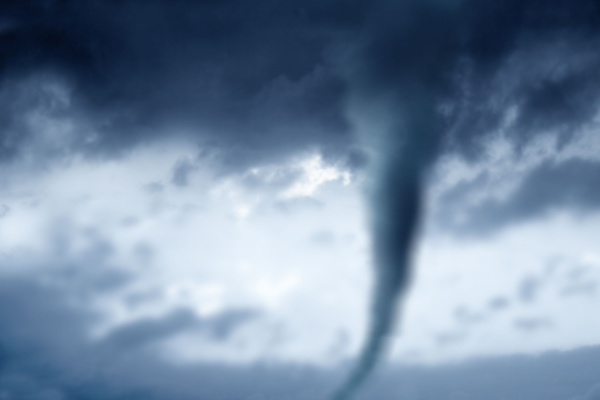
February is here and with it comes cold weather and the beginning of a new severe weather and apparently, early tornado season.
The evening of 19 February featured a rare-for-the-midwest winter tornado outbreak. Tornadoes were reported in several locations in southern Illinois and Indiana, accompanied by numerous reports of hail and damaging winds. Much of the severe weather happened after dark as well. Multiple tornadoes were reported across the two states, with the most significant being an EF2 tornado with a nearly four mile long track in the western part of Bloomington, Indiana.
A long-lived supercell thunderstorm dropped at least two confirmed tornadoes to the ground that night. After surveying the damage Friday, the National Weather Service confirmed an EF0 tornado touched down in Sullivan County shortly before 7 p.m. with top winds of 85 mph. The tornado was on the ground for 4.1 miles. A short time later, an EF2 tornado, with winds of 120 mph, hit Bloomington around 7 p.m. That tornado was on the ground for 3.73 miles.
February is Not Known for Tornadoes
As The Weather Channel reports, February is not known for tornadoes. In fact, February is one of the least tornadic months in the year, with totals only reaching into the 40s. But they do happen.
They are typical in much of the South, but they can happen anywhere conditions are favorable. But any average tends to smooth out wide variations. February tornado counts in recent years have ranged from a record high of 147 in 2008 – we’ll come back to that later – to a low of just one tornado in 2010.
When tornadoes occur in in February, it’s mainly in the Deep South, but also in the Ohio Valley or parts of the Carolinas from time to time. The elevated southern risk is because of its proximity to the Gulf, where warm, moist air can surge northward faster, adding instability to the atmosphere. That warm air clashes with cold air near the surface brought on by a strong jet stream, combining the ingredients for thunderstorms capable of bringing tornadoes.
Where February Tornadoes Have Hit in Recent Years
According to The Weather Channel, some years love to follow this trend, while others don’t.
February 2025 was very much on trend. The bulk of the tornado reports were located across the Southeast and the Tennessee River Valley. However, 2024 was quite special. According to NOAA’s Storm Prediction Center, 45 tornadoes were confirmed in the U.S. that February.
But it’s where they happened that made that month so weird. In 2024, the majority of those tornadoes were in the Midwest, not in the South. Most bizarre of all, Wisconsin had its first February tornado in records dating to before statehood on Feb. 8, 2024. One of the tornadoes was both strong (rated EF2) and was on the ground for 26 miles.
Then, fueled by record February and winter warmth before month’s end, 23 tornadoes touched down from northern Illinois into Lower Michigan, Ohio and New York state from Feb. 27-28. That included southeast Michigan’s second February tornado on record, an EF2 at that.
Historical And Notable Tornado Outbreaks
Large February outbreaks have happened before. Both recent and past history have shown February can generate destructive and deadly outbreaks, despite the low average numbers.
The Super Tuesday outbreak of Feb. 5-6, 2008, had the most tornadoes for a single February event, with 86 confirmed over 10 states responsible for 57 tornado-related deaths. Five tornadoes were rated EF4. One of these tracked 122 miles across Arkansas, the longest tornado path of record in that state.
A Feb. 21-22, 1971 outbreak claimed 121 lives from Texas to North Carolina, the deadliest February rash of tornadoes in recent times. One F4 tornado near Oxford, Mississippi, killed 58 and injured 800 others, the deadliest single February tornado since 1950.
Finally, a Feb. 19-20, 1884 outbreak spawned a swarm of stronger tornadoes across eight states in the Southeast. At least 182 deaths were documented, but since it’s not known for certain how many tornadoes or deaths occurred, the outbreak was dubbed “The Enigma Outbreak”, according to weather historian Christopher Burt.
Winter Tornadoes Are Dangerous – You Need to Prepare
The Weather Channel states that several factors make winter severe weather outbreaks dangerous.
Storms move rapidly: Severe thunderstorms can often move at speeds above 55 mph, given the strength of steering winds aloft. This is why it’s best to take shelter immediately when you receive a warning. Don’t waste precious time by going outside or looking out the window first. If you’re in a warning, you’re in danger.
Tornadoes can be rain-wrapped: Brief, rain-wrapped tornadoes can sometimes form with little warning when they’re embedded in long squall lines of severe thunderstorms, even if no supercell thunderstorms develop. In some supercell tornadoes, rain might hide the tornado.
Straight-line wind damage: A fast-moving squall line of severe thunderstorms can produce straight-line winds on the order of those estimated with EF0 or, in rarer cases, EF1 tornadoes. Downed trees, power lines and even structural damage are possible in these situations, without a tornado in progress.
Severe weather can happen any hour of the day: Severe thunderstorms in winter can erupt overnight or in the morning, not necessarily during the typical late-afternoon or evening time frame, with such strong winter jet-stream energy.
Do you know where to take shelter if you receive a tornado or severe thunderstorm warning in the middle of the night? How would you receive that warning? If you don’t have one, it’s time to review or develop a severe weather plan.
—
Photo Credit: jokerpro / Shutterstock.com