One second in Ann Arbor has prompted the NCAA to tighten its procedures for college football replay reviews.
The NCAA has issued standardized guidance governing how replay officials handle game-clock adjustments following the controversial finish between Michigan and Western Michigan, a game decided only after officials restored a second that appeared to have disappeared.
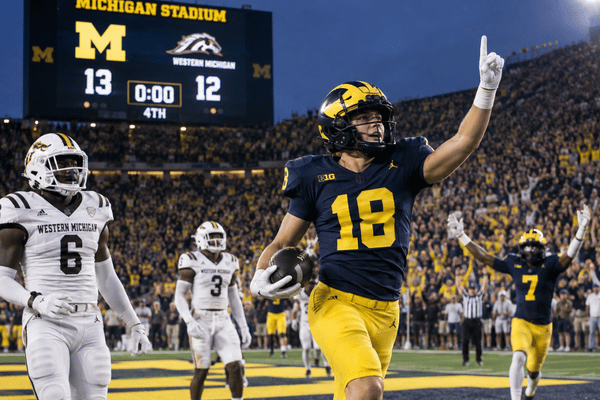
Michigan escaped with a 13-12 victory, but getting there required one of the strangest finishes of the young college football season.
With Michigan desperately trying to avoid an upset, quarterback Bryce Underwood launched a late Hail Mary that fell incomplete. The game clock reached zero, apparently giving Western Michigan a dramatic victory.
Not so fast.
Officials reviewed the play and determined that Western Michigan defender Micah Davis, who had established himself out of bounds, touched the football while one second remained according to the timing information used during the review.
That single second changed everything.
Michigan was given another snap, and Underwood took advantage of it, connecting with JJ Buchanan for the game-winning touchdown and turning what appeared to be a Western Michigan celebration into a stunning Wolverines victory.
The aftermath quickly shifted from the final touchdown to the clock itself.
Questions emerged over which timing source replay officials should rely upon when determining whether time needs to be restored. The NCAA has now moved to establish a consistent procedure across college football.
Under the clarified protocol, the time displayed on the in-stadium game clock remains the official time. When replay officials must determine whether time should be restored or otherwise adjusted, they are to use the embedded game clock contained within the program feed.
The clarification is designed to prevent different replay crews from relying on different timing sources when every fraction of a second matters.
That may provide more consistency going forward, but it has not ended the debate over what happened in Ann Arbor.
The Mid-American Conference later challenged the handling of the final seconds, arguing that established replay protocol had not been properly followed and that Western Michigan should have been credited with the victory.
The NCAA, however, has said the result will remain unchanged. Its rules do not provide a mechanism for reversing a game’s final outcome in circumstances such as these.
Michigan therefore keeps the victory in the record book.
College football, meanwhile, gets a new timing protocol.
For a sport accustomed to games being decided by inches, this one may be remembered for being decided by a second.
