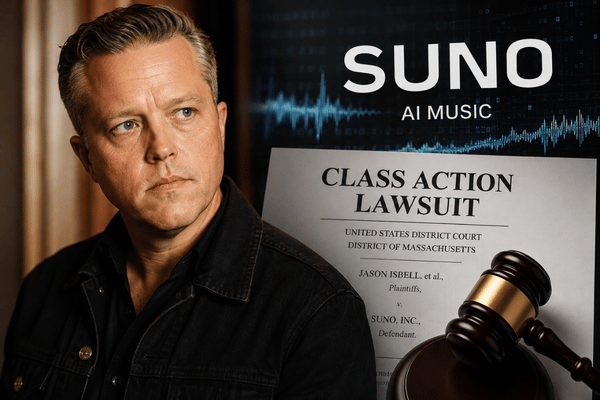
Jason Isbell is taking his concerns about artificial intelligence in music to federal court, joining several fellow musicians in a class-action lawsuit against AI music platform Suno.
The case puts a different spin on the growing legal confrontation between musicians and generative AI companies. Rather than concentrating solely on ownership of songs and recordings, the plaintiffs are challenging the alleged use of an artist’s identity as part of the technology and the commercial products built around it.
Isbell is joined in the action by David Lowery, known for his work with Cracker and Camper Van Beethoven, Texas blues musician Guy Forsyth and saxophonist Eduardo Calle.
The lawsuit, filed Aug. 31 in U.S. District Court in Massachusetts, argues that a musician’s identity has independent commercial value and cannot simply be absorbed into an AI platform without authorization.
At the center of the dispute is the ability of generative music systems to create new material based on detailed user instructions. The plaintiffs contend that references associated with recognizable musicians can steer the technology toward results connected to those artists, allowing their identities to contribute to a commercial service without their consent.
Suno has put safeguards in place designed to prevent straightforward requests to imitate specific performers. The lawsuit challenges whether those restrictions are sufficient, alleging that alternative descriptions and identifying information can still be used to work around them.
That distinction could make the case particularly significant for musicians. Artists do not necessarily own every recording on which they perform, since recording rights can belong to labels or other parties. The lawsuit argues that rights connected to a performer’s identity are a separate matter and should remain under the artist’s control unless specifically licensed.
The action arrives as the music business continues wrestling with the consequences of rapidly improving generative AI. Questions over what material can be used to develop AI models, how resulting music should be treated and when creators deserve permission or compensation have moved from industry debates into courtrooms.
Isbell and his fellow plaintiffs are now pushing another question into that discussion: whether a technology company can commercially benefit from the recognizable identity of a musician without reaching an agreement with that artist.
The answer could have implications extending well beyond these four musicians. If the case succeeds as a class action, it could help establish new boundaries around how artist identities are handled by companies building and selling generative music technology.
There is even a bit of science-fiction humor accompanying an otherwise serious legal fight. The musicians’ legal team has referenced the Borg, the collective-minded Star Trek villains associated with the warning that resistance is futile.
For Isbell and the musicians joining him in court, resistance appears to be precisely the point.
