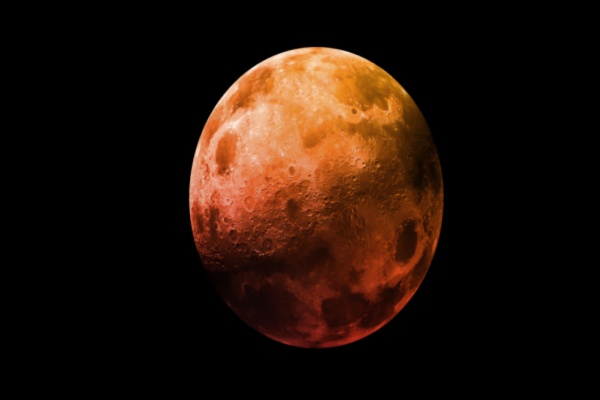
The moon will turn red this weekend during the second and final total lunar eclipse of 2025, an event that most of the world’s population should be able to see, weather permitting.
As AccuWeather reports, it’s often called a Blood Moon, because the eclipsed moon will take on a deep red hue at its peak. The color shift is caused by the Earth, as the only light that reaches the moon during totality first passes through the planet’s atmosphere, which distorts the color of sunlight similar to vivid sunrises and sunsets.
85% of the World’s Population Can See It
About 85% of the world’s population lives in regions where Sunday’s total lunar eclipse will be visible, according to TimeandDate.com. That includes many of the planet’s most densely populated areas, such as Asia, Europe, Africa, Australia and New Zealand. Unfortunately for skywatchers across North America and South America, the eclipse will end before the moon rises Sunday evening.
The total eclipse will last for 1 hour and 22 minutes, starting at 17:30 UTC, and ending at 18:52 UTC. For people in the area where the eclipse is visible, the best time to look will be at the midpoint of the event at 18:11 UTC. A partial lunar eclipse will also be visible leading up to and immediately following the total phase.
It’s Not a Harvest Moon… Yet
Sunday’s eclipse occurs during the final full moon before the changing of the astronomical seasons, which takes place during the equinox on Sept. 22. In North America, the full moon has several nicknames that date back to colonial times, including the Corn Moon, the Rutting Moon and the Autumn Moon.
This year is one of the rare times when September’s full moon is not the popular Harvest Moon, the nickname given to the full moon that rises closest to the equinox. In 2025, that name will be linked to the full moon that rises on Oct. 6.
After September, the next total lunar eclipse will take place on March 2-3, 2026, and it will be visible across part of North America, South America, Asia, Australia and New Zealand.
—
Photo Credit: Dima Zel / Shutterstock.com