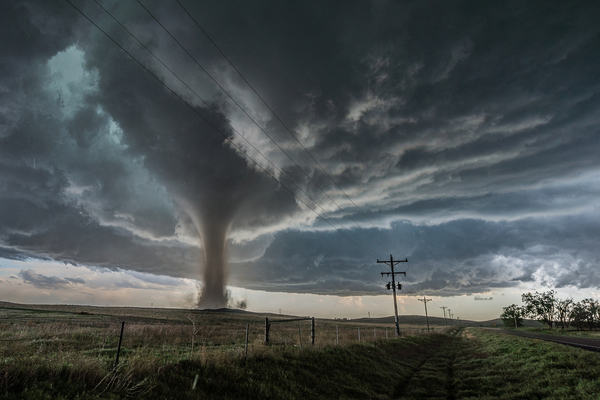
Spawned by the raging interactions of powerful thunderstorms, tornadoes are some of the most awe-inspiring and destructive natural forces seen in the United States each year.The most frequent and devastating tornado events tend to occur in the region of the U.S. colloquially referred to as Tornado Alley.
Tornado Alley earned its moniker due to the high frequency of tornadoes that consistently touch down across the plains from late spring to early fall each year. “Tornado Alley is an area of the U.S. where there is a high potential for tornado development,” AccuWeather Senior Meteorologist Dan Kottlowski said. “This area encompasses much of northern Texas northward through Oklahoma, Kansas, Missouri and parts of Louisiana, Iowa, Nebraska and eastern Colorado.”
Unlike other parts of the U.S., this region is most vulnerable to tornado development because contrasting air masses frequently collide to produce strong and violent thunderstorms, which in turn, set the stage for tornado development. Residents in the region have long suffered damage to homes, cars and other property due to the severe weather. According to the Insurance Information Institute, also called Triple-I, tornadoes and other severe weather drove $51 billion in U.S. insured losses in 2025, with total economic damage topping $68 billion.
But as US News reports, recent trends suggest that the Tornado Alley most people know has begun shifting east, moving into the Mississippi River valley and up through the Great Lakes. In this new geography, the damage is more difficult to track and report due to changes in the landscape and visibility.
The New Tornado Alley: A Shift to the East and Southeast
Sometimes referred to as Dixie Alley, the states that make up the new Tornado Alley include Alabama, Arkansas, Illinois, Indiana, Kentucky, Mississippi, Missouri and Tennessee. Portions of other states, such as Florida, Georgia, North Carolina and South Carolina, may also be considered part of Dixie Alley.
While the original Tornado Alley still gets its fair share of inclement weather, work led by Northern Illinois University meteorology professor Victor Gensini has documented an eastward shift of up to 500 miles in tornado activity from Texas and Oklahoma.
The frequency of tornadoes shows several key trends, including increased year-to-year variability and a recent pattern where more tornadoes occur at a given time. Additionally, the annual timing of tornado season has shifted, likely due to severe drought in the southwest U.S over the past two decades.
Some recent studies have indicated a rise in tornado frequency in the eastern United States and a decrease in weather events in the original Tornado Alley. The drought brings drier air to the Central Plains, pushing the storm track toward the moisture-rich environment of the Southeast.
Some Debate Among Experts
There is some debate among experts over exactly how the definition of Tornado Alley may be changing. Some sources argue that Dixie Alley has always been an area with high tornado activity, separate from Tornado Alley. Others indicate that the dividing line between the arid western states and humid eastern states, often referred to as the 100th meridian, is moving eastward due to climate change; this directly impacts the number of tornadoes in a given area and is pushing Tornado Alley to the east.
“Dixie Alley is a west-east oriented oval-shaped offshoot of the original Tornado Alley in the central U.S.,” says Kottlowski. “These areas like the Plains states have a higher potential for tornado development,” Kottlowski said. “Activity leading to tornado development across Dixie Alley often originates across the original Tornado Alley.”
—
Photo Credit: Cammie Czuchnicki / Shutterstock.com
