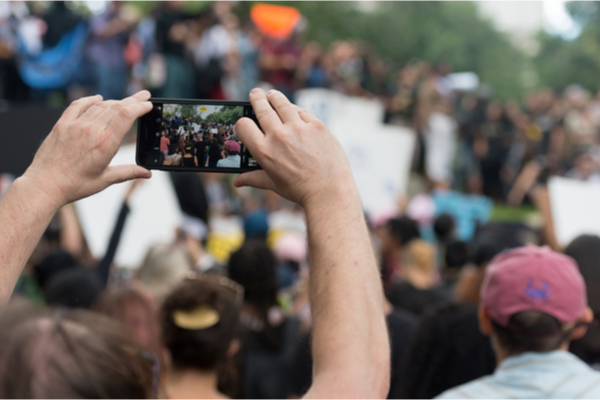
While showing up at a protest can demonstrate your opinion to the world, you may not want your face — or the faces of other protesters — to be included, especially when there is the possibility that authorities will collect and use that information (as they have for tracking movements during COVID-19 social distancing). As a result, many consider it vital to obscure the faces of people in any photos you may post on social media and other online sources. The tech experts at The Verge have put together strategies for removing facial features from your photos. Of course, you can open up your images on a desktop or laptop using Photoshop or Preview to blur or scrub, but we’re going to assume you aren’t carrying around a laptop with you. So with mobile in mind, you still have some solid options.
What needs to be done
When removing faces, you want to use a method that can’t be reversed. It is possible to de-blur a photo, especially using neural networks. It’s not possible to completely reverse the blurring, since it is lossy (in other words, some data will be permanently lost), but a lot can be “restored.” So why take the risk? Painting over faces, or using mosaic blur techniques, will prevent any possibility of reversing the effect.
You also want to remove any and all metadata from your images. They can carry GPS location, timestamps, and details about the type of phone used — basically, lots of things that can be used to pinpoint where you were and when.
Built-in methods
While there are a plethora of apps that will help blur or cover faces and remove metadata for both iOS and Android devices (some of which I mention below), there are ways you can do both without using a third-party app. First, you can use your built-in photo editor to individually block out faces. On iOS, open Photos, tap on your photo and select the Edit option (in the top right corner). Tap on the three dots in that same corner to access Markup. With that, create solid circles or squares to block out faces.
It’s not quite as easy using an Android phone. Android also has a native markup tool — in the Photos app, select the photo, tap on the Edit tool (second from the left on the bottom) and choose Markup (second from the right on the bottom). You can then use the center-bottom Pen tool to scribble over anything you want to cover.
You then want to get rid of the metadata. When you take a photo on your device, meta is going to be attached automatically. The easiest way to avoid this is to take screenshots of your photos so that meta and geotagging won’t carry over. Also make sure to view your photo fullscreen, and ensure you don’t have any notifications or other identifying features in the screenshot.
The same can be done for video — at least, using an iPhone. Instead of just using the Camera app, start a screen record while you’re making your video, and use that recording instead. If you have an LG or Samsung Android phone, you may also have a built-in screen recorder — look for it in your Quick Settings shade by swiping down twice from the top. If it’s not there, or if you have a different phone model, you’ll have to download a third-party app such as AZ Screen Recorder.
Third-party apps that hide faces & remove meta
Recently, there have been a plethora of apps that will help hide faces and remove metadata for both iOS and Android devices. You may find it easier to use one of these.
For example, encrypted messaging app Signal has announced a new face-blurring tool that will be incorporated into the latest Android and iOS versions of the software.
There are also grassroots efforts like Image Scrubber, which you can use in a browser on your device to upload images to blur and scrub, and then to save the anonymous version back to your device. This is great because it works on all devices, mobile and desktop.
If you already use apps to edit and enhance photos, you might be able to use those to blur as well. Apps like Glitche (iOS) and Glitch Lab (Android) let you pixelate over selected areas, and Trigraphy (iOS) lets you create mosaic effects. If you want to take photos now and remove the meta later, you can use the apps mentioned above or photo apps like Halide (iOS) and Snapseed (Android).
In the end, the method you choose will depend on how much work you want to do during or after the fact.
For additional information, here’s a toolkit produced by the Authority Collective, offering information and advice on this subject.
—
Photo Credit: Ian Warren / Shutterstock.com