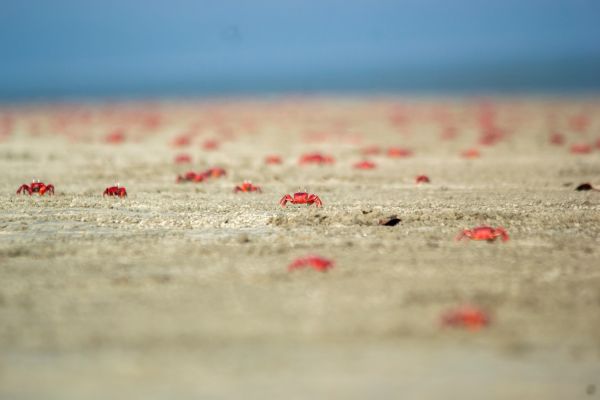
Red crabs are making their annual migration to the ocean to mate and spawn, creating a spectacle that fills roads in Australia with scuttling crustaceans and prompts temporary road closures to help them cross safely.
The mass migration produces a distinctive scraping and chittering sound as the crabs move together, creating an almost rainfall-like noise. The annual event is one of Australia’s Christmas Island’s most remarkable natural spectacles, attracting attention from nature enthusiasts around the world.
Christmas Island, an Australian territory in the Indian Ocean more than 200 miles off the Indonesian island of Java, is home to the species.
Rain is the Signal
As AccuWeather reports, behind the remarkable scene is a schedule shaped by the first rain of the wet season and a narrow spawning window tied to the lunar cycle. First, rain gives millions of red crabs the signal to leave the forest on Australia’s Christmas Island.
According to Christmas Island National Park, the migration typically begins with rainfall in October or November, although the start can come as late as December or January. This year’s migration was underway by Nov. 14, with millions of crabs making their way across the island’s roads and specially constructed bridges, according to Euronews. The entire journey usually takes about 9 days, with the males leading the way, and females joining the fray as the crabs move toward the ocean.
The crabs wait for the first rains before beginning their journey, making rainfall essential to the annual migration. If the rain arrives close to the ideal spawning date, the crabs may hurry toward the coast. If it comes too late, some will remain in their burrows and wait until the following month.
A lack of rain can delay or even prevent the migration, according to a 2013 Princeton University study published in the journal Global Change Biology. During the particularly dry 1997 season, the crabs did not migrate or mate, Princeton researchers said. The conditions were linked to a strong El Niño, a climate pattern associated with dry conditions in the Indian Ocean.
The Moon Sets the Clock
That first rainfall sets the journey in motion, but the crabs cannot simply arrive whenever they please. The moon determines how much time they have to reach the coast. Females release their eggs before dawn as high tide recedes during the moon’s last quarter.
If the rain arrives close to that spawning window, the crabs must move quickly. An earlier start allows a more leisurely journey, with stops to eat and drink along the way. Once they reach the coast, male crabs typically arrive first and dig burrows. Females join them to mate in or near the burrows.
Male and Female Crabs Part Ways
Reaching the coast is only part of the journey. After mating, males begin returning to the forest while females remain behind in moist burrows as their eggs develop.
Each female can produce up to 100,000 eggs. When the spawning window arrives, they gather along the shoreline and release their eggs into the sea before heading inland. The eggs hatch almost immediately upon contact with the water. The larvae spend about a month developing at sea before survivors return to shore as tiny crabs and begin their own journey toward the forest.
Most of the larvae do not survive, becoming food for fish, manta rays and whale sharks. However, once or twice a decade, unusually large numbers survive and return to shore, helping maintain Christmas Island’s red crab population, according to the national park.
The mass movement can temporarily reshape daily life on the island. Some road sections close for part or all of the day during peak migration, sometimes with little notice. Special bridges over roads provide crossings for the crabs.
The annual event is available to watch on a livestream.
—
Photo Credit: rima das mukherjee / Shutterstock.com
