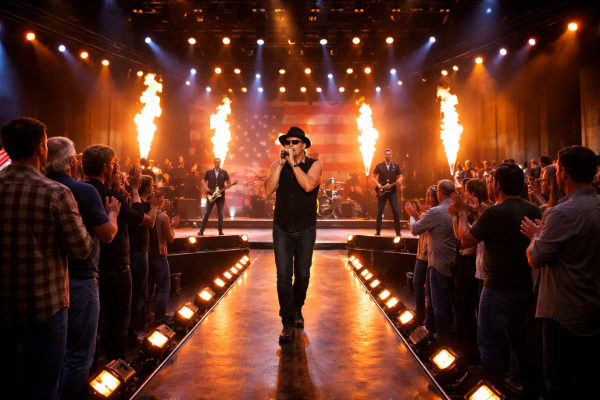
TPU took aim at Super Bowl halftime culture by offering its own “All-American Halftime Show,” pitched as an alternative for viewers uninterested in the NFL’s choice of headliner. While the concept suggested confrontation, the execution leaned heavily toward restraint.
Rather than a fiery rebuttal to the main event, the 35-minute program unfolded as a mild, polished sequence of country and rock performances. Without an announcer or visible branding, the broadcast offered little indication of where or when it was filmed, creating the feel of a throwback cable music special rather than a live cultural statement.
Brantley Gilbert opened the show after an instrumental take on the national anthem, delivering a rock-leaning country set that set the tone for the evening. Gabby Barrett followed with a polished, mainstream country-pop performance anchored by her early hits. Lee Brice then took the stage, mixing familiar material with a newly debuted song that introduced the most explicit political commentary of the night, touching on cultural divisions and personal identity.
Kid Rock closed the program in front of a modest studio audience, opening with a heavily produced version of “Bawitaba” complete with pyrotechnics. His final song, a cover of Cody Johnson’s “Till You Can’t,” included newly written lyrics that shifted the message toward evangelical themes. Aside from that moment, his brief spoken remarks were limited and restrained.
The show concluded with a visual tribute to Charlie Kirk, reinforcing the organization’s role in producing the broadcast while leaving many practical details unexplained. Despite being framed as a competing event, the program avoided referencing the Super Bowl halftime show or its star at any point during the broadcast.
Online viewership reflected modest curiosity rather than mass migration. YouTube numbers peaked during Kid Rock’s appearance before tapering off as the football game resumed. Additional distribution through platforms like OAN expanded reach, though no comprehensive audience total was immediately available.
In the end, the “All-American Halftime Show” positioned itself less as a protest and more as a comfort broadcast. It offered familiar sounds, familiar faces, and a carefully controlled tone, suggesting that its primary goal was reassurance rather than disruption.