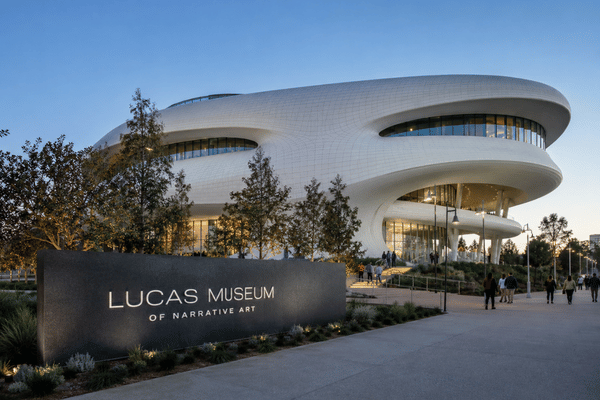
After years of planning, detours and anticipation, George Lucas is finally ready to open the doors to a museum that reaches well beyond the universe that made him one of Hollywood’s most influential filmmakers.
The Lucas Museum of Narrative Art opens September 22 in Los Angeles’ Exposition Park, bringing together an enormous collection devoted to the ways people have told stories through images across generations and cultures.
Founded by Lucas and his wife, businesswoman Mellody Hobson, the museum occupies a striking futuristic building designed by architect Ma Yansong of MAD Architects with Stantec. The roughly 300,000-square-foot structure includes more than 100,000 square feet of gallery space across more than 30 galleries.
And yes, there is plenty here to make a Star Wars fan feel the Force.
The opening exhibitions include “Star Wars in Motion,” a showcase exploring the vehicles that helped define the visual language of the first six movies in Lucas’ saga. Visitors will encounter production artwork, costumes and props connected to everything from Luke Skywalker’s Landspeeder to the high-speed machines of the prequel trilogy.
A bright yellow Naboo N-1 Starfighter also makes an appropriately dramatic appearance inside the museum.
R2-D2, C-3PO and other familiar pieces from Lucas’ cinematic universe help give movie fans another reason to make the pilgrimage to Exposition Park.
But anyone expecting 300,000 square feet of Star Wars memorabilia is in for a surprise.
The franchise represents only a small part of a much bigger idea.
Lucas and Hobson have built the institution around narrative art, essentially the art of telling stories visually. Its collection stretches across centuries and includes painting, illustration, photography, comic books, manga, murals, cinema and other forms that traditional art museums have not always placed on equal footing.
The inaugural exhibitions bring more than 1,300 works into the galleries, with artists ranging from Norman Rockwell and Frida Kahlo to Diego Rivera, Charles Schulz, Frank Frazetta, Jim Lee and Banksy.
That eclectic lineup reveals the museum’s central argument: a comic-book panel, movie concept drawing or magazine illustration can tell stories and shape culture just as powerfully as works hanging in the world’s established fine-art institutions.
Lucas has spent decades collecting that kind of work, and the new museum effectively gives his philosophy a permanent home.
The experience extends beyond the galleries. The complex includes theaters, educational and studio spaces, a research library, restaurants and landscaped public areas designed to turn the property into more than a destination for movie buffs.
For Lucas, whose career has been built around creating worlds audiences wanted to enter, the project represents a different kind of storytelling achievement.
Star Wars may provide the museum with some of its most recognizable attractions, but the larger mission is considerably more ambitious: putting popular visual storytelling alongside traditional art and arguing that both belong in the same cultural conversation.
After a long journey to get the museum built, Lucas now has a very real place to make that case.
