California-based tech firm WiCi has a new wireless external GPU (eGPU) and enclosure that lets any Wi-Fi-connected laptop play games using an integrated Nvidia RTX 5060 Ti 16GB. Questions remain about range, latency, and performance ceilings, but WiCi’s promo video at least showcases what the technology can manage, according to VideoCardz, who first reported the news.
As PCMag reports, most eGPUs connect to host devices via a high-speed connector, such as OCuLink or Thunderbolt 3/4/5. These can offer up to 64Gbps of throughput over PCI Express (PCIe), which is a lot, but it’s still not enough for top-tier GPUs, which typically suffer a performance penalty compared with their desktop counterparts, especially if you’re feeding it back to the laptop’s internal screen.
That may be why WiCi isn’t launching out of the gate with an RTX 5090 solution, but rather a more modest RTX 5060 Ti 16GB. Like other eGPUs, it’s installed in its own box with its own power and cooling system, but this one connects over Wi-Fi 7; no wires other than the power cable are required.
That should mean you can play games on your laptop, desktop, or tablet without a dedicated GPU, but use the eGPU’s power to render them. It looks smooth in the promo video, but I still have a lot of questions.
The first is whether Wi-Fi 7 is actually up to the task. It’s incredibly fast, but not a patch on dedicated Thunderbolt 5 speeds, and even that can run into bottleneck issues with eGPUs. Wi-Fi 7 has a theoretical, lab-condition maximum bandwidth of 48Gbps, but in practice, it’s likely to deliver far less. VideoCardz points out that with the WiCi’s 4×4 radio configuration, its available throughput may be limited to less than 12Gbps.
If so, it’s not clear if it would even have enough to offer the full performance of a 5060 Ti. That could still be more than whatever onboard GPU you have, and wireless connectivity is more convenient than plugging in a cable every time you want to use it.
But the convenience of wireless is also about not needing to be near the source machine or device, and in this case, that’s likely to be necessary. The further you are from the WiCi eGPU system, the worse the bandwidth and latency. You’re also increasing the risk of furniture, walls, or other Wi-Fi signals interfering.
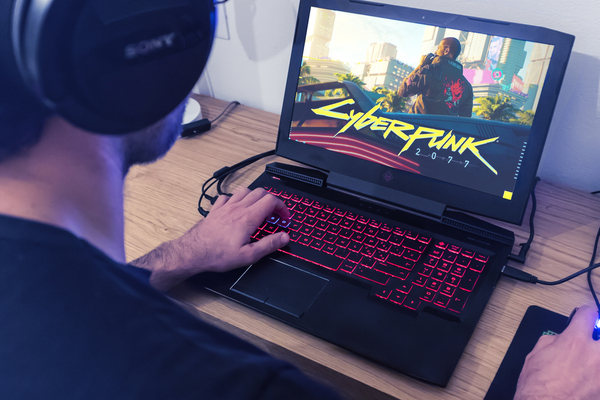
In its internal testing, WiCi claims this system can render Cyberpunk 2077 at 4K Ultra with DLSS 4 at up to 80fps, while Black Myth: Wukong can reach 60fps at 4K Cinematic with DLSS support. It doesn’t detail whether frame generation was part of that equation.
While this is a fun potential use of the technology and will undoubtedly become more viable as wireless bandwidth and latency continue to improve (Wi-Fi 8 isn’t that far off), the WiCi’s original intended use is likely more viable—a dedicated AI inferencing device in your home that a variety of devices can connect to for more powerful local AI capabilities.
With all the inferencing handled on the device itself, only the prompt and response need to travel, and that’s far less latency-sensitive anyway. That’s where the upcoming RTX 5090 version of this might make sense. For gaming, though? I don’t see it.
The WiCi One isn’t on sale yet, but you can register to reserve one for $2,000. Retail price will be $2,600 with the RTX 5060 Ti; 5090 pricing to come.
—
Photo Credit: Martina Badini / Shutterstock.com
