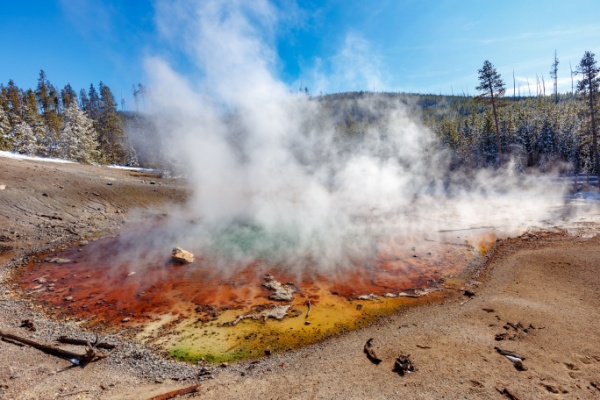
Yellowstone National Park’s Echinus Geyser is doing something visitors have not seen in years: it’s erupting again.
As AccuWeather reports, on Feb. 7, the geyser logged its first eruption since 2020, according to the U.S. Geological Survey’s Yellowstone Volcano Observatory. More eruptions followed, and by Feb. 16, activity had ramped up to eruptions every 2 to 5 hours.
Echinus is the largest acidic geyser in the world, with an acidity similar to that of orange juice or vinegar. The pool is about 66 feet across, rimmed with a red band created by minerals including iron, aluminum and arsenic.
The current burst of activity looks more like a short wake-up than a long-term comeback. Recent eruptions have lasted only a few minutes and reached about 20 to 30 feet, and the USGS notes Echinus has a habit of becoming active for a month or two before going quiet again. It may already have slowed down, with no eruptions recorded during the last few days of February.
That’s a dramatic shift from decades ago when Echinus Geyser erupted every 40 to 80 minutes. In the 1980s and 1990s, eruptions sometimes lasted more than 90 minutes and reached about 75 feet.
The geyser’s activity faded in the early 2000s, then returned briefly in 2017 before going quiet again.
For anyone hoping to catch the action in person, the simplest advice is also the most important: stay on the boardwalk, follow posted closures and give all thermal features plenty of space.
—
Photo Credit: Atmosphere1 / Shutterstock.com