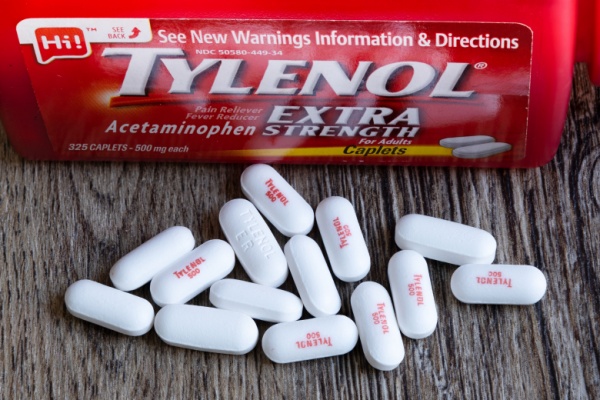
The painkiller acetaminophen or paracetamol is one of the most widely taken drugs during pregnancy, used by roughly half of all pregnant people worldwide.
But as Nature reports, on Monday, the US Food and Drug Administration (FDA) announced that it would slap a new warning label on the drug, citing a “possible association” between autism in children and the use of acetaminophen, also called Tyenol in the United States, during pregnancy.
President Donald Trump, however, was not as nuanced in his language. In an extraordinary news conference at the White House, Trump delivered medical advice to pregnant women and parents of young children, repeatedly telling them not to use or administer the painkiller and suggesting that common vaccines not be taken together or so early in a child’s life. “So taking Tylenol is not good. All right. I’ll say it. It’s not good. For this reason, they are strongly recommending that women limit Tylenol use during pregnancy unless medically necessary. That’s, for instance, in cases of extremely high fever, that you feel you can’t tough it out. You can’t do it. I guess there’s that.”
“It’s a small number of cases, I think. But if you can’t tough it out, if you can’t do it, that’s what you’re going to have to do. You’ll take a Tylenol, but it’ll be very sparingly. It can be something that’s very dangerous to the woman’s health, in other words, a fever that’s very, very dangerous and ideally a doctor’s decision because I think you shouldn’t take it and you shouldn’t take it during the entire pregnancy…. So ideally, you don’t take it at all.”
Researchers Say there is Insufficient Data to Link the Cause of Autism to Acetaminophen
Autistic people show differences in social communication and interaction, and reported prevalence of autism has risen in some countries in recent decades. But many researchers who study autism caution that there is insufficient data to link the cause of autism to acetaminophen and that focusing on such a link is no more than a distraction.
“There is no definitive evidence to suggest that paracetamol use in mothers is a cause of autism, and when you see any associations, they are very, very small,” says James Cusack, chief executive of Autistica, a UK autism research and campaigning charity in London, who is autistic. “At the heart of this is people trying to look for simple answers to complex problems.” Experts say that Tylenol is most often taken during pregnancy to reduce fevers, and the fever itself – or the underlying medical condition that caused the fever – is the more likely cause of any resulting medical issues.
At Monday’s announcement, US Health Secretary Robert F. Kennedy Jr acknowledged that autism has many possible causes. FDA commissioner Martin Makary noted that, in some cases, insufficient transport of the nutrient folate into the brain has been linked with traits common in autism. But Kennedy, a long-time anti-vaccine advocate, and Trump focused their attention on two other factors that they said could be linked to autism: acetaminophen and vaccines. Decades of research have repeatedly found no reproducible link between vaccines and autism.
“The evidence does not support a causal link between acetaminophen or vaccines and autism,” says Sura Alwan, a clinical teratologist at the University of British Columbia in Vancouver, Canada, and executive director of PEAR-Net Society, a nonprofit advocating for maternal fetal health and research. “Suggesting otherwise may fuel misinformation and undermine confidence in safe treatments and immunizations.”
Most Robust Research Does Not Link Autism to Acetaminophen Use During Pregnancy
As the Nature journal reports, scientists say that the most robust research does not link autism to acetaminophen use during pregnancy. “The better controlled studies are less likely to find even a small risk,” says Helen Tager-Flusberg, a psychologist who studies autism at Boston University, Massachusetts, “And even then, what we’re talking about is a minor association. … We do not think that taking acetaminophen is in any way contributing to actually causing autism.”
Working out whether there is a link between the drug and autism is difficult, says Viktor Ahlqvist, an epidemiologist at the Karolinska Institute in Stockholm and co-author of what might be the biggest study on the link. The medication is available over the counter, so a lot of usage is not recorded in medical databases. This means researchers rely on self-reports, which can be unreliable.
Confounding factors are an even bigger problem. Women who take paracetamol in pregnancy are usually in poorer health than those who don’t, perhaps because they had an infection or an underlying condition. Any apparent link between acetaminophen and autism might therefore be explained by these other health factors rather than the drug itself. Although scientists try to adjust for such confounders in their studies, such adjustments are “rarely sufficient,” Ahlqvist says. This is one reason why studies looking for a link have produced conflicting results.
The study led by Ahlqvist harnessed data on nearly 2.5 million children born in Sweden between 1995 and 2019 and — from the country’s extensive health records — data on acetaminophen prescriptions during pregnancy and on self-reported use collected by midwives, as well as whether children later received autism diagnoses. The study showed that around 1.42% of children exposed to acetaminophen during pregnancy were autistic, compared to 1.33% of children who were not exposed ─ a “very small” difference, says Ahlqvist.
The team also compared pairs of siblings (born to the same mother), one of whom had been exposed to acetaminophen and one who had not. Siblings share half of their genome, and share a similar upbringing and mother’s background health, so any detected difference in autism between siblings is more likely to be due to the drug. The researchers found no association between acetaminophen and autism using this method — which supports the idea that links found in other studies were really explained by confounding factors.
Another large, high-quality study from Japan including over 200,000 children — also using sibling comparisons and published this year — found no link between acetaminophen use in pregnancy and autism.
Medical Community Decries the Announcement
As Reuters reports, dozens of medical, research, and autism advocacy groups, including the American Academy of Pediatrics (AAP) and the American College of Obstetricians and Gynecologists (ACOG), decried the president’s announcement.
“It is clear that the Tylenol-autism link is not a new question – it has been looked at many times and in many different studies,” autism researcher Dr. Diana Schendel of the A.J. Drexel Autism Institute said in a statement, noting that she would like to see what new evidence the administration comes up with. “Without showing any evidence to back them up, the announcements become reckless and potentially harmful.”
“The data cited do not support the claim that Tylenol causes autism and leucovorin is a cure, and only stoke fear and falsely suggest hope when there is no simple answer,” the Coalition of Autism Scientists said in a statement.
“We believe independent, sound science clearly shows that taking acetaminophen does not cause autism. We strongly disagree with any suggestion otherwise and are deeply concerned with the health risk this poses for expecting mothers and parents,” Kenvue, the maker of Tylenol, said in a statement.
Both ACOG and AAP urge women who are pregnant or thinking about becoming pregnant consult with, and take the advice of their medically trained physician, rather than a politician.
Trump Administration’s Next Steps
The Trump administration has suggested leucovorin, a form of folinic acid, as a treatment for autism symptoms, and has asked drug companies to be prepared to ramp up production of leucovorin as a treatment for some autism patients, FDA chief Marty Makary told reporters.
The FDA has approved a version of the drug made by GSK that was aimed at treating a condition associated with autism, but which the drugmaker no longer manufactures. Once it is established for the use, the administration said Medicaid insurance for low-income people would cover the drug for autism symptoms.
The FDA, in its approval process, cited a review of the use of leucovorin in 40 patients with a rare metabolic disorder called cerebral folate deficiency that can lead to a range of neurological symptoms, some of which are seen in people with autism.
However, researchers say leucovorin, used to treat some cancer patients on chemotherapy, has shown some promise in very small trials, but that large, randomized trials are still needed. “There’s not good evidence that it works. There are some studies, but they’re small and they’re not the best studies. And so it’s certainly not something I’m actively recommending,” said Dr. Audrey Brumback, an autism expert and researcher at the University of Texas at Austin.
The FDA said it would seek a label change for over-the-counter Tylenol and its generic versions to reflect evidence suggesting that use during pregnancy may be associated with an increased risk of neurological conditions such as autism and ADHD in children. The FDA also sent a letter to doctors with a similar warning, but said a causal relationship had not been established.
—
Photo Credit: James Are / Shutterstock.com