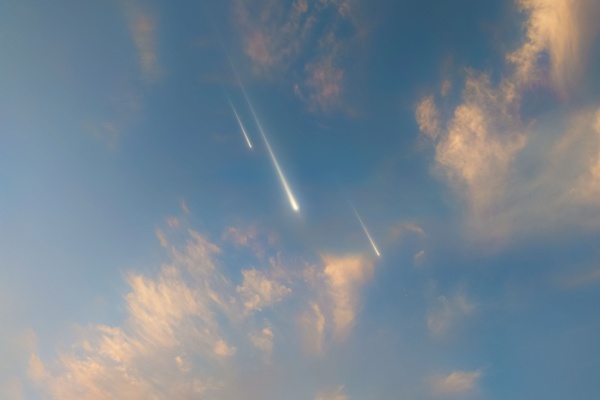
Were you one of the many across the southeastern U.S. last week who watched and wondered – and maybe even flipped out – about a fireball streaking through the sky in the broad daylight?
Well, that “fireball” turned out to be a bright meteorite, a.k.a. space debris, careening out of the cosmos towards earth. As CBS News reports, the American Meteor Society said it received more than 160 reports of a fireball sighting from observers in Georgia and South Carolina at 12:25 p.m. ET. The meteor was first seen at an altitude of 48 miles above the town of Oxford, Georgia, moving southwest at 30,000 miles per hour, said Bill Cooke, a lead at NASA’s Meteoroid Environment Office.
The meteor was “visibly flaring as the extreme heat of atmospheric friction overwhelmed the ancient chunk of solar system debris,” according to Space.com. Its descent was bright enough to be seen by the National Oceanic and Atmospheric Administration’s (NOAAs) GOES-19 Earth observation satellite, using an instrument designed to map flashes of lightning from orbit.
According to NASA, the meteor ended its cosmic journey through the Earth’s atmosphere in brilliant fashion, exploding over Georgia, creating booms heard by residents in the area, and even punching a hole through one Georgia home.
“Daylight fireballs are rare in that it takes a large object (larger than a beachball compared to your normal pea-sized meteor) to be bright enough to be seen during the day,” said Robert Lunsford of the American Meteor Association in an email to Space.com. “We probably only average one per month worldwide, so perhaps one out of every 3,000 reports occurs during the day.” Lunsford said the fireball may have been associated with the daylight beta Taurid shower, which peaks in late June as Earth passes through the trail of cosmic debris shed by the ancient solar system comet 2P/Encke.
“Being much larger than your average meteor also means that it has a better chance of producing fragments on the ground,” explained Lunsford. “We look for reports of sound such as thunder or sonic booms to have confidence that fragments of the original fireball survived down to the lower atmosphere and perhaps all the way to the ground. Therefore the photograph of the hole in the roof is probably associated with this fireball.”
If verified, the Georgia meteorite wouldn’t represent the first time that a daylight beta Daylight Taurid left a mark on our planet. Lunsford noted that a particularly large meteor that some scientists believe to be associated with the annual shower detonated in a powerful airburst 6 miles (9.6 kilometers) over Russian Siberia. The force of the explosion sparked massive forest fires and flattened roughly 80 million trees in what has since become known as the ‘Tunguska Event’. But keep in mind, that was over 100 years ago, in June 1908.
—
Photo Credit: Nazarii_Neshcherenskyi / Shutterstock.com