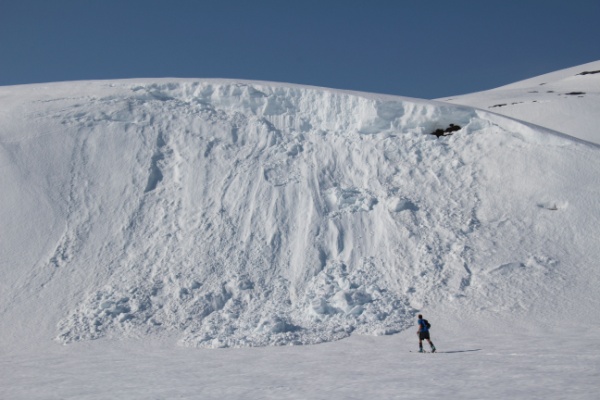
A snowboarder was killed in an avalanche in central Colorado on Saturday, marking just the latest fatality stemming from avalanches in the western U.S. this season.
Authorities in Grand County responded Saturday to what they described as a skier-triggered avalanche in a steep area known as “The Fingers” above Berthoud Pass. It was the second reported avalanche in the county that day. A few people were caught in the other slide but were uninjured. The coroner’s office identified the victim as Nathan Ginn of Littleton.
As KTVB7 in Boise, Idaho, reports, Saturday’s avalanche death is the third in Colorado this winter and the second fatality in less than a week in that state, according to the Colorado Avalanche Information Center. A Crested Butte snowboarder was killed Feb. 20 in a slide west of Silverton. Elsewhere, three people died in avalanches Feb. 17 — one person near Lake Tahoe and two backcountry skiers in Oregon’s Cascade Mountains. On Feb. 8, a well-known outdoor guide was caught in an avalanche in Utah and was killed.
In California, Mammoth Mountain confirmed Saturday in a social media post that a member of the ski patrol there died from injuries sustained in an avalanche that occurred last week. Officials said Claire Murphy was one of two ski patrol staffers who were caught in a slide during avalanche mitigation work being done the morning of Feb. 14.
The mitigation work followed a major a storm that dumped about 6 feet (1.8 meters) of snow over 36 hours in the Sierra Nevada. The other ski patroller caught in that avalanche was extracted and was responsive, while Murphy was taken to a hospital with injuries. “Our hearts are with her family and our community as we navigate this tragedy together,” Mammoth Mountain said in its post.
February is Historically the Deadliest Avalanche Month
According to Denver 7 News, February is historically the deadliest month for avalanches in Colorado, and Mother Nature’s power has been on full display in the past 10 days with more than 500 recorded avalanches, 14 people caught and two deaths. In both of the fatal slides, the snow broke several feet deep and the slide spread across wide mountain faces, according to the Colorado Avalanche Information Center (CAIC).
On Feb. 14, CAIC warned that mid-February can bring some of the busiest and deadliest time for avalanches, which is typically due to improving snow conditions overlapping with increasing avalanche danger. Since the center made that warning, Colorado has recorded 517 avalanches, which marks 17% of the total number this season. Of those, 69 were considered “very large,” CAIC said. “Avalanche conditions are dangerous,” CAIC’s forecast read on Sunday afternoon. “You likely won’t see or hear any warning signs before triggering a deeply breaking, deadly avalanche.”
Each winter, 25 to 30 people die in avalanches in the U.S., according to the National Avalanche Center. The center’s current map shows moderate and considerable risks in parts of Colorado, Utah and Idaho while avalanche warnings are in place for areas in Washington and neighboring Montana.
The Grand County Sheriff’s Office in Colorado issued a message Sunday urging backcountry recreational enthusiasts to always carry essential equipment and check daily avalanche forecasts.
CAIC stressed that stability tests on the snow are not reliable in these conditions. “You can trust the avalanche data, though, and there is no clearer sign of a dangerous snowpack than large, widely breaking avalanches — especially when there are lots of them,” CAIC’s forecast reads.
Avalanche Warnings spread to Upstate New York
New York leaders are warning the risk of avalanches are at an all-time high and warn you should “avoid” many areas.
The New York State DEC took to Facebook to warner New Yorkers about the increased risk of avalanches. “Since we haven’t had a major thaw this winter to knock down the weak layers of snow near the bottom of the snowpack, new snowfall causes the snowpack to just keep accumulating, growing larger and larger and simultaneously more unstable. Unstable snow = avalanche-prone snow,” the DEC wrote on Facebook.
According to the New York State DEC, avalanches are most common during the month of February. They are most common in the Adirondacks and “during or shortly after a large snowstorm.” Officials say the risk of an avalanche is very high because of the two major snowstorms over the previous weekends.
What Causes an Avalanche
Also known as “snowslides”, an avalanche is a mass of snow sliding down a mountainside. Avalanches can occur in any situation where snow, slope and weather conditions combine to create proper conditions.
An avalanche occurs when the stress (from gravity) trying to pull the snow downhill exceeds the strength (from bonds between snow grains) of the snow cover. Four conditions must be present for an avalanche to occur:
- a steep slope,
- snow cover,
- a weak layer in the snow cover, and
- a trigger.
Avalanche danger increases with major snowstorms and periods of thaw. About 2,000 avalanches are reported to the U.S. Forest Service Avalanche Center in an average winter. More than 80 percent of these occur during or just after large snowstorms. The most avalanche-prone months are, in order, February, March, and January. Avalanches caused by thaw occur most often in April.
How to Avoid Getting Caught in an Avalanche
If you’re an outdoor adventurer and love heading to the hills when a fresh snowpack beckons, there are simple and effective ways of staying safe.
- Know basic avalanche rescue techniques. Visit the National Avalanche Center’s webpage (leaves DEC website) for more information.
- Check the snow depth.
- Check how much new snow has fallen.
- Practice safe route finding.
- Check the degree of the slope.
- Check the terrain. The NYSDEC states that there are a number of places that are “more prone to avalanches.” These include: High-elevation trails, slopes between 30-45 degrees (where 90% of all avalanches start), and Northeastern slopes, which get less sun leading to more persistent weak layers in the snow.
- Carry basic avalanche rescue equipment.
- Never travel alone.
- Let someone know where you are going.
- Do not be afraid to turn around.
- Use common sense.
Always check the latest conditions. The premiere site for checking avalanche conditions anywhere in the United States is Avalanche.org, which is a partnership between the American Avalanche Association (A3) and the US Forest Service National Avalanche Center (NAC). The site consolidates data from professional forecast centers to provide real-time avalanche information.
Here are other more localized avalanche agencies, by state:
In Colorado, the CIAC recommends always checking their website for the latest conditions. “… Let recent avalanches be your guide. Realize that these are challenging conditions and ones that get people killed. Don’t let your guard down, and start pushing into more consequential terrain. The snowpack is proving to be very unforgiving, and stability is slow to come. Keep your terrain choices conservative, and be patient.”
To check avalanche conditions in the Pacific Northwest, you can access information provided by the Northwest Avalanche Center (NWAC), which provides daily avalanche forecasts for areas in northern Oregon and Washington state and also the Central Oregon Avalanche Center. You can find their information online on their website or through the Avalanche.org platform.
You can check avalanche conditions in Idaho at Avalanche.org, the Sawtooth Avalanche Center, the Payette Avalanche Center, and the Idaho Panhandle Avalanche Center.
In New York, you can check the Avalanche.org website, as well as the Adirondack Community Avalanche Project.
—
Photo Credit: BriefcaseToBackback / Shutterstock.com