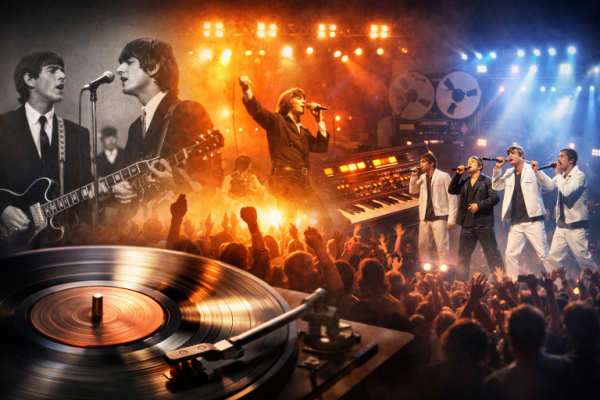
April 17 has quietly built a reputation as a date that delivers defining moments in music history, spanning decades and genres while showcasing the evolution of popular sound.
The timeline begins in the early 1960s when The Rolling Stones introduced their debut album to the UK. The release marked the arrival of a band that would go on to shape rock music for generations. Their raw, blues-inspired sound contrasted sharply with the polished pop of the era, signaling a shift that would ripple through the industry.
By 1971, the charts were dominated by a different kind of energy. Three Dog Night captured the top spot in the United States with “Joy to the World,” a track that blended rock with an infectious, singalong spirit. Its success reflected a growing appetite for accessible, feel-good anthems during a time of cultural change.
A decade later, April 17 saw a cinematic turn. Vangelis reached No. 1 with the theme from “Chariots of Fire,” a composition that fused electronic elements with orchestral grandeur. The track not only defined the film it accompanied but also demonstrated how instrumental music could achieve mainstream chart success.
The late 1990s brought a surge of polished pop dominance, and April 17 played its part once again. Backstreet Boys secured the top position in the UK with “I Want It That Way,” a song that became synonymous with the boy band era. Its global impact underscored the power of pop music to transcend borders and connect with a wide audience.
Taken together, these moments reveal a pattern. April 17 is more than just another date on the calendar. It serves as a snapshot of music’s ongoing transformation, from gritty rock beginnings to polished pop phenomena and everything in between.
