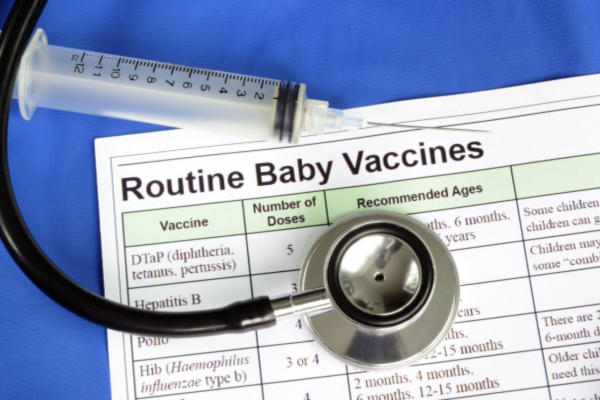
The CDC’s new vaccine advisory committee met Friday and voted to drastically reduce children’s access to vaccines.
As Forbes reports, most importantly, the U.S. Centers for Disease Control and Prevention’s (CDC’s) Advisory Committee on Immunization Practices voted 8-3 to reverse the decades-long policy of administering the first dose of hepatitis B vaccine within 24 hours of a baby’s birth.
Instead, the members focused on a narrower, risk-based approach, recommending the vaccine only for infants whose mothers test positive for the disease. If a mother tests negative, ACIP recommends that she decides if and when the baby should be protected, in consultation with a healthcare professional. The problem with that approach is that many mothers are not screened for hepatitis B, and other family members and friends can transmit the disease to newborns.
The committee also recommended delaying the initial vaccine dose to 2 months and following it up with a blood test to see if the baby need further doses, something that has no data to support it. Plus, there’s no mandate that insurers cover this additional lab testing. The ACIP’s recommendations are non-binding, but are usually followed by the CDC director.
In anticipation of the meeting, a Washington Post editorial presciently described the Advisory Committee on Immunization Practices as “CDC’s next anti-vaccine clown show.”
Here’s why this committee has been raising so much concern.
RFK Jr. Hand-Selected Committee of Vaccine Skeptics
Robert F. Kennedy Jr. fired all 17 ACIP members on June 9, replacing experts with decades of experience who had undergone the CDC’s standard, thorough vetting process. He hand-selected inexperienced new members, many of whom have been outspoken as strongly opposed to vaccines.
Some, like Kennedy himself, have been involved in lawsuits against vaccine manufacturers and have promoted discredited research. Concerns over the membership changes prompted the American Academy of Pediatrics to boycott the committee’s June meeting.
Thursday’s meeting was focused on the birth dose of the hepatitis B vaccine, given within 24 hours of delivery. This neonatal dose has been shown to dramatically decrease the incidence of acute hepatitis B since it began being administered in 1991. As a result of this vaccination, chronic hepatitis B has dropped by a staggering 99%.
The American Public Health Association states that the universal hepatitis B vaccine birth dose has prevented more than 500,000 childhood infections and an estimated 90,100 childhood deaths.
Most new members of the vaccine advisory group have advocated for a risk-based approach. They argue that almost all at-risk babies get the infection from their mothers. This strategy has been shown repeatedly to fail. It misses mothers who might not get good prenatal care and have not been screened. It also misses that many babies are infected by other household members or, later, by schoolmates. Hepatitis B can be spread through contaminated objects and is a hardy virus that can survive for up to a week.
CDC Subject-Matter and Outside Pharmaceutical Experts Were Not Invited
Notably, CDC subject-matter experts and outside pharmaceutical experts, who are usually invited to present data, were not invited, a departure from past practice.
Many members have preferred recommending the vaccine at birth only for infants born to mothers with hepatitis B infections. Otherwise, most want the first dose of vaccine delayed for at least two months, at which point parents and doctors can decide whether and when to immunize based on “shared decision making.” (Note: parents already consent to treatments.)
This vaccine group faced the same questions at its last meeting in September and delayed the vote because the wording of the questions changed several times. Some members wanted more time to consider the nuances of the wording, as they had not been provided with written copies of it. Once again, they had to delay the vote Thursday due to last-minute changes in wording.
“The committee meeting showed bias, lack of scientific understanding, non-transparency and incompetence,” said Dorit Reiss, a professor of law and member of the Vaccine Working Group on Ethics and Policy, in an email.
Lawyer and vaccine critic Aaron Siri was scheduled to brief the ACIP committee, which outraged Republican Sen. Bill Cassidy of Louisiana, a physician and chair of the Senate Health, Education, Labor and Pensions Committee. “Aaron Siri is a trial attorney who makes his living suing vaccine manufacturers,” said Cassidy, who hesitated to vote to confirm Kennedy but did so after assurances that Kennedy wouldn’t try to remove access to vaccines. “He is presenting as if an expert on childhood vaccines. The ACIP is totally discredited. They are not protecting children.”
“An Epidemiological Crime Scene”
Some felt that only babies of high-risk mothers should receive birth doses of the vaccine. The problem with this is that it misses many babies, who then might develop hepatitis B and its complications, which include cancer.
ACIP member Vicky Pebsworth blamed gay men, “promiscuous” women, and immigrants for spreading hepatitis B. Member Evelyn Griffin said that “illegal immigrants” are to blame. And member Michael Belkin declared that hepatitis B is a disease of “gays, junkies and promiscuous heterosexuals.”
Defend Public Health’s cofounder and epidemiologist Elizabeth Jacobs described the attempt to restigmatize hepatitis B infections as “an epidemiological crime scene.”
Some members feel the vaccines are dangerous and kill babies, claims that are not supported by available scientific evidence after decades of safety monitoring.Others said newborn vaccination is uncommon in other countries, so we should not be an outlier. However, widely known international data contradicts that claim.
“Even Short Delays Lead to Substantially More Infections, Severe Long-Term Health Complications, and Increased Healthcare Spending”
A new study showed that “even short delays in vaccination lead to substantially more infections, severe long-term health complications, and sharply increased healthcare spending.” It did not improve safety.
- “By delaying the birth dose to 2 months among infants whose mothers are not known to be living with hepatitis B, there could be at least 1,400 preventable hepatitis B infections among children, 300 excess cases of liver cancer, 480 preventable deaths and over $222 million in excess healthcare costs, for each year the revised recommendation is in place.
- If the birth dose was delayed to 12 years, this would balloon to at least 2,700 preventable hepatitis B infections and $313 million in excess healthcare costs for each year.”
Nurse Teri Mills, cofounder of Grandparents for Vaccines, said in an email, “If the newborn hepatitis B dose is eliminated the next generation of babies will undergo immense and unnecessary suffering.”
In an opinion piece, Drs. Demetre Daslakakis, Daniel Jernigan and Debra Houry, former CDC leaders who resigned after CDC Director Susan Monarez was fired this summer, said, “Altering the hepatitis B birth dose could destabilize the entire childhood schedule. Combination vaccines that include hepatitis B depend on stable timing.”
The U.S. currently doesn’t have the capacity to produce single-dose formulations, they added. This would result in gaps in protection and might force manufacturers to leave the U.S. market. “The committee must resist raising hypothetical risks not grounded in rigorous science, while burying real, lifesaving benefits,” they warned. “The country deserves better — and our public health system depends on it.”
—
Photo Credit: JohnKwan / Shutterstock.com