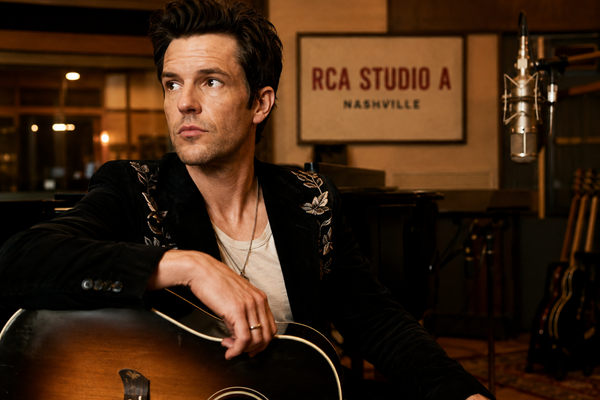
Brandon Flowers has spent more than two decades living a version of the musician’s dream, but these days the frontman of The Killers is increasingly curious about the road he didn’t take.
At 45, Flowers is contemplating the demands that come with a career built on albums, arenas and years of touring. He has even found himself wondering what his life might have looked like without The Killers, the band that transformed him from an aspiring Las Vegas musician into an internationally recognized frontman.
Those thoughts arrive at an interesting moment. Rather than walking away from making records, Flowers is preparing to release some of his most personally rooted music yet.
His third solo album, “Thrasher,” arrives August 21 and represents a significant move toward country and Western music. Recorded at Nashville’s Historic RCA Studio A, the project reconnects Flowers with sounds that stretch back well before the synths, guitars and neon imagery associated with The Killers.
Country music was part of his childhood through his father, whose record collection included figures such as Johnny Cash and Waylon Jennings. Flowers absorbed those sounds alongside the alternative and British music that would eventually help shape his own musical identity.
Decades later, that early influence has moved to center stage.
For “Thrasher,” Flowers retained trusted collaborators Shawn Everett and Jonathan Rado while surrounding himself with musicians steeped in American roots traditions. Guitarist David Rawlings, pedal-steel veteran Bruce Bouton and harmonica player Charlie McCoy are among the musicians involved in the Nashville sessions.
The result places Flowers firmly in country territory without suggesting that he has suddenly disowned rock music. Elements of Americana and Western storytelling have surfaced throughout his career, particularly on The Killers’ 2021 album “Pressure Machine,” which drew inspiration from his formative years in the small Utah town of Nephi.
“Thrasher” takes that instinct further.
It also arrives as Flowers appears increasingly comfortable separating creative satisfaction from expectations about what a Killers frontman is supposed to sound like. After years of making music capable of filling enormous venues, his attention has shifted toward storytelling, personal history and songs connected to the places and people that shaped him.
That doesn’t mean The Killers are finished. Flowers has continued discussing future music from the band, while additional solo material is also waiting in the wings.
What has changed is his willingness to question the machinery surrounding success.
The younger Flowers chased a career in music and wound up with one far bigger than he could reasonably have predicted. The older Flowers seems more interested in determining which parts of that life are still worth chasing.
For now, the answer appears to be found somewhere between Utah and Nashville, with country songs providing a new home for stories that have been following him for years.
Flowers may be wondering how long he wants to keep living the traditional rock-star cycle, but “Thrasher” suggests his desire to write songs is very much alive. Instead of quitting music, he has found another direction in which to take it.
