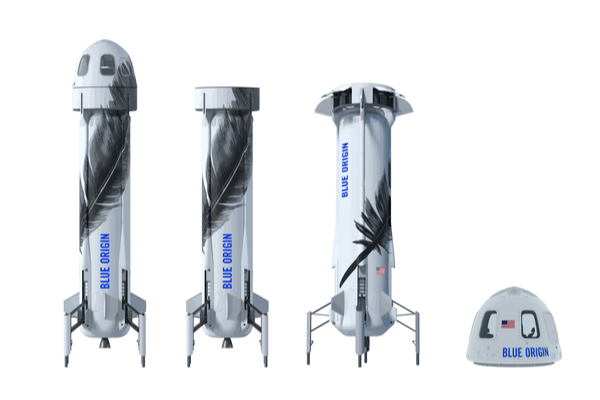
Florida’s Space Coast will feature a lot more Blue Origin structures on the ground and rockets in the sky under plans the company just posted.
As PCMag reprots, the Jeff Bezos-owned space enterprise aims for a massive increase in flights with its New Glenn rockets, both the current version, first launched in January 2025, and a future super-heavy-lift model revealed in November of that year.
Step one of Blue’s buildout plans is a $330 million expansion of its Rocket Park campus, already an impressive sight across Space Commerce Way from the entrance to the Kennedy Space Center Visitor Complex. That property spans about a mile north to south; Blue’s post says that when this new project concludes in the summer of 2027, it will support building as many as 150 upper stages for the upcoming New Glenn 9×4 version.
Blue CEO Dave Limp posted a video on X showing the inside of the new factory and what appeared to be dozens of second stages roosting under its rafters. That name refers to the nine methane-fueled BE-4 engines in its reusable first stage and the four hydrogen-fueled BE-3U engines on its second stage, which combined can send 77 tons to low Earth orbit. Today’s 7×2 version, with seven BE-4s in its reusable booster and two BE-3Us in its upper stage, can put almost 50 tons of payload into low Earth orbit.
That rocket has now flown three times, successfully landing each booster on a landing-platform ship named Jacklyn (after Bezos’s mother) after November 2025 and April 2026 launches. But a catastrophic on-pad explosion in May destroyed much of New Glenn’s only launch infrastructure and grounded the vehicle.
Blue has since been hustling to get Cape Canaveral Space Force Station’s Launch Complex 36 rebuilt. Under its latest plans, New Glenn’s launch cadence will increase exponentially. The company already has a request with the Federal Aviation Administration (FAA)to step up LC-36 launches from 12 to 50 annually. But the facilities described in Friday’s post—and its prediction of “multiple flights per week by the end of the decade”—suggest that Blue will soon enough file to raise that cap even further.
The company plans to build two more launch pads, in addition to the one now under repair and a second now under early construction next to it, for New Glenn 9×4 launches, with two new integration facilities near LC-36 to support the preparation of multiple vehicles and payloads. And Jacklyn will see some sisters join her at Port Canaveral: Blue is now working to procure two more landing-platform vessels.
Blue may be assuming that New Glenn will draw far more launch customers than this rocket has so far, but it has the non-obvious advantage that SpaceX appears to be ceding much of the satellite-launch market. That company’s Falcon 9 and Falcon Heavy rockets currently dominate the business, but Elon Musk’s space company seems increasingly set on focusing on launching its own Starlink satellites and transitioning those deliveries to its super-heavy lift Starship.
That giant, fully reusable rocket finally reached orbit on its 14th launch in September, but the version currently flying is designed only to deploy Starlink V3 satellites through a thin slot of a payload-bay door. SpaceX has yet to publish details about a general-purpose cargo version of Starship. But before anybody at Blue can get into any trash talk about eating SpaceX’s lunch, the company needs to return New Glenn to flight. It already has two of the most important customers in the private and public sectors waiting on that.
Amazon booked that rocket years ago for 12 launches of its Amazon Leo broadband satellite constellation; other, smaller rockets that have already delivered just under 400 Leo satellites can’t carry as many as New Glenn can. NASA, meanwhile, awarded Blue a $3.4 billion contract in 2023 to build a series of Blue Moon lunar landers for its Artemis program, with one expected to get a check-out in Earth orbit by astronauts on the Artemis III mission planned for 2027.
SpaceX also aims to have a lunar-lander version of Starship’s second stage–something NASA ordered up in 2021 with a $2.89 billion contract–ready for Artemis III as well, but that company is also well behind its own schedule projections. Blue Origin has kept saying it can complete LC-36 repairs and launch New Glenn again by the end of this year, which would be an extraordinary achievement in spaceflight.
Earlier in October, Bezos repeated those pledges in an interview with Fox News anchor Brett Baier, saying the company aims to return this rocket to flight “sometime in December” before joking a moment later that it will “probably be Dec. 31.”
—
Cape Canaveral Space Force Station’s Launch Complex 36
