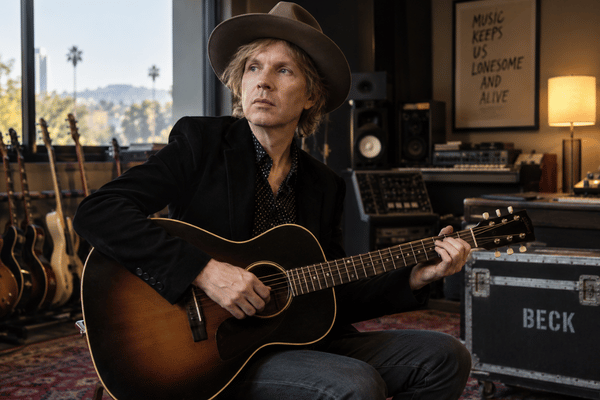
More than three decades after “Loser” unexpectedly turned him into one of alternative music’s most distinctive stars, Beck is still following the instinct that helped make his career so difficult to categorize in the first place.
His latest album, Ride Lonesome, arrives September 18 and finds the Los Angeles musician returning to a more reflective side of his songwriting. The project was shaped during a turbulent chapter of his personal life following his 2021 divorce from actress Marissa Ribisi, with themes of isolation, uncertainty and emotional recovery running through the record.
It is familiar territory for Beck, whose 2002 album Sea Change transformed heartbreak into one of the most introspective releases of his career. Ride Lonesome revisits some of that emotional landscape while drawing additional inspiration from the lonely journeys and unforgiving scenery associated with classic Western films.
For an artist famous for jumping between folk, hip-hop, funk, psychedelia, electronic music and rock, Beck says quieter contemplation is actually one of his creative defaults. The playful records can require more effort because humor and lightness demand a different frame of mind.
That contrast has followed him almost from the beginning.
Before “Loser” became an unlikely breakthrough in 1994, Beck had spent years developing experimental acoustic songs and performing on the fringes of the anti-folk scene. Then a strange combination of blues, rap and alternative rock suddenly connected with a huge audience.
The success opened virtually every door imaginable. After Odelay further established him as a major artist, opportunities arrived from Hollywood, television and advertising. Beck could have turned his unconventional fame into a much larger celebrity enterprise.
Instead, he frequently said no.
One of the artists who helped shape that attitude was Neil Young. Beck came to see Young as an example of how a musician could experience enormous commercial success without allowing the machinery surrounding that success to dictate every artistic decision.
For Beck, that example reinforced something increasingly important: trusting his own instincts, even when doing so meant walking away from potentially lucrative opportunities.
His refusal to settle into one predictable lane also reflected the musical environment of his childhood. Growing up in Los Angeles exposed him to a mixture of Latin music, rap, rock and traditional singer-songwriters. Rather than treating those sounds as separate worlds, Beck eventually combined them into his own musical vocabulary.
Albums such as Mellow Gold and Odelay turned that collision of influences into a signature. What once seemed unusual became increasingly commonplace as genre boundaries across popular music began to loosen.
Ride Lonesome shows another side of that same restless musical personality. Beck’s father, composer and arranger David Campbell, contributed string arrangements, adding orchestral texture to a project centered on solitude and endurance.
Despite the album’s focus on difficult periods, Beck does not appear interested in slowing his creative pace. He continues spending much of his week working in the studio and says he already has a substantial amount of future material in progress.
That may be the clearest connection between the artist who stumbled into fame with “Loser” and the veteran songwriter making Ride Lonesome decades later.
The sounds change. The circumstances change. Beck keeps making records on his own terms.
