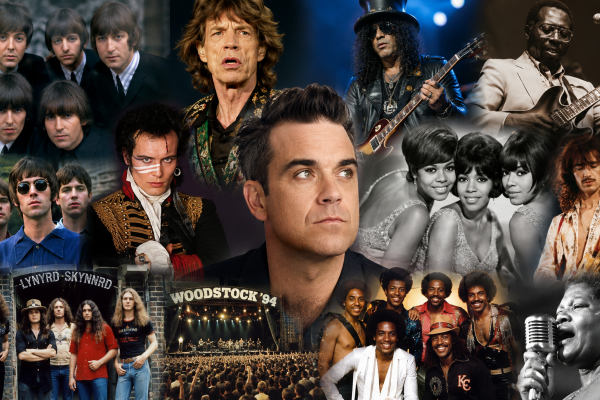
August 13 has delivered more than its share of unforgettable moments in music, from breakthrough performances and chart triumphs to courtroom drama, accidents and milestones that changed artists’ lives forever.
One of the date’s most memorable pop stories came in 2004, when Robbie Williams’ “Angels” was named in a VH1 poll as the best single never to reach No. 1. The song had climbed to No. 4 in the UK in 1997, but its staying power ultimately became far greater than its original chart peak suggested. Other fan favorites in the poll included songs by Savage Garden, Aerosmith, Madonna, Bon Jovi and Oasis.
The date also carries several dramatic chapters from the rock world. In 1999, Mick Jagger’s marriage to Jerry Hall was declared invalid by a London court, closing one chapter of their long relationship without the drawn-out legal battle many had expected. That same year, former Guns N’ Roses guitarist Slash was arrested in Los Angeles after being accused of assaulting his girlfriend. He was later released on bail.
Five years earlier, members of Oasis and The Verve found themselves in trouble in Sweden after an incident involving damage at a hotel bar and a break-in at a church. The same year also brought one of the defining festivals of the 1990s, Woodstock ’94, which drew more than 350,000 fans to Saugerties, New York. Green Day, Nine Inch Nails, Aerosmith and Red Hot Chili Peppers were among the acts on a bill built for maximum volume.
August 13 has also marked major career highs. Neil Diamond opened a six-night sold-out run at Madison Square Garden in 1992 during a hugely successful touring year. In 1983, KC and the Sunshine Band held the top spot on the UK singles chart with “Give It Up,” while Yes celebrated a UK No. 1 album in 1977 with Going for the One, an album that also welcomed keyboardist Rick Wakeman back into the lineup.
For Lynyrd Skynyrd, August 13, 1973 marked the beginning of an era. The band released its debut album, introducing a collection of songs that would become central to its legacy, including “Simple Man,” “Gimme Three Steps,” “Tuesday’s Gone” and “Free Bird.”
The date also includes moments of extraordinary resilience and profound loss. In 1990, Curtis Mayfield was paralyzed from the neck down after lighting equipment fell on him during an outdoor concert in Brooklyn. Even after the accident, he continued making music and later released another album. In 1982, soul singer Joe Tex died after suffering a heart attack, while in 1971 saxophonist King Curtis was fatally stabbed outside his New York home.
John Lennon also began a major new chapter on August 13, 1971, when he flew from Britain to New York. He would never again return to British soil. During the same year, Pink Floyd performed in Australia for the first time, opening another international chapter in the band’s growing career.
The 1960s supplied several milestones of their own. Fleetwood Mac made its live debut in 1967 at the National Jazz and Blues Festival in Windsor. A year earlier, The Beatles’ Revolver began a seven-week run at No. 1 in the UK, while The Lovin’ Spoonful topped the U.S. singles chart with “Summer in the City.”
In 1965, The Beatles arrived in New York for another North American tour during the feverish height of Beatlemania. That same year, Jefferson Airplane played its first live show at San Francisco’s Matrix Club, helping signal the rise of a new West Coast sound.
Motown also owns a piece of August 13 history. In 1964, The Supremes recorded “Baby Love,” which would become another enormous success for the group. Manfred Mann was also at No. 1 in the UK that year with “Do Wah Diddy Diddy.”
Go back even further and the date reaches one of the foundations of rock and R&B history. In 1952, Big Mama Thornton recorded the original version of “Hound Dog,” a powerhouse performance that became a major R&B hit and helped establish the songwriting team of Jerry Leiber and Mike Stoller.
Taken together, the events of August 13 read like a compressed history of popular music itself: triumph, reinvention, controversy, heartbreak and songs that refused to disappear.
