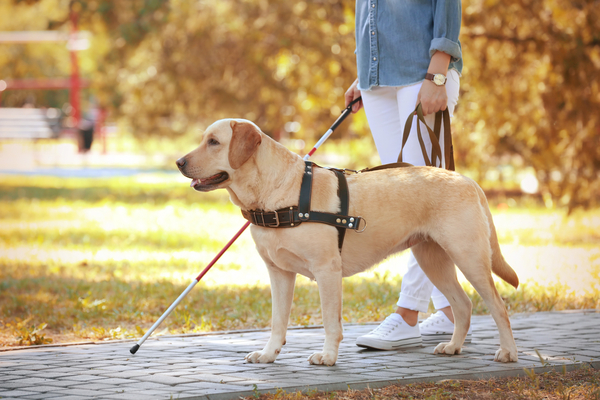
Happy International Guide Dog Day! This day, celebrated annually on the last Wednesday in April, brings attention to the importance of guide dogs and how they help the blind and visually impaired live their daily lives.
Guide dogs are carefully trained to avoid obstacles, access public transportation, cross roads safely, and other daily tasks to help their person’s specific needs.
The History of Guide Dogs
While this day marks the establishment of the International Federation of Guide Dog Associations on 26th April 1989, references to guide dogs date back hundreds and hundreds of years. According to the International Guide Dog Federation (IGDF), perhaps the earliest recorded example is depicted in a first-century AD mural in the buried ruins of Roman Herculaneum. There are other records from Asia and Europe up to the Middle Ages, of dogs leading blind men.
However, the first systematic attempt to train dogs to aid blind people came around 1780 at ‘Les Quinze-Vingts’ hospital for the blind in Paris. Shortly afterwards, in 1788, Josef Riesinger, a blind sieve-maker from Vienna, trained a Spitz so well that people often questioned whether he was blind.
The modern guide dog story, however, begins during the First World War, with thousands of soldiers returning from the Front blinded, often by poison gas. A German doctor, Dr. Gerhard Stalling, got the idea of training dogs en masse to help those affected. While walking with a patient one day through the hospital grounds, he was called away urgently and left his dog with the patient as company. When he returned, he saw signs, from the way the dog was behaving, that it was looking after the blind patient. Dr. Stalling started to explore ways of training dogs to become reliable guides and in August 1916 opened the world’s first guide dog school for the blind in Oldenburg.
But it was American Dorothy Harrison Eustis who is credited with bringing the guide dog training methods from Europe to the United States in the late 1920’s. Eustis was already training dogs for the army, police and customs service in Switzerland. Having heard about the Potsdam guide dog training center, Eustis was curious to study the school’s methods and spent several months there. She came away so impressed that she wrote an article about it for the Saturday Evening Post in America in October 1927.
A blind American man, Morris Frank, heard about the article and bought a copy of the newspaper. He later said that the five cents the newspaper cost him “bought an article that was worth more than a million dollars to me. It changed my life”. He wrote to Eustis, telling her that he would very much like to help introduce guide dogs to the United States.
Taking up the challenge, Dorothy Eustis trained a dog, Buddy, and brought Frank over to Switzerland to learn how to work with the dog. Frank went back to the United States with what many believe to be America’s first guide dog. Eustis later established the Seeing Eye School in Morristown, New Jersey, in 1929.
About Guide Dogs of America
The non-profit organization Guide Dogs of America, founded over 70 years ago, sponsors this event.
Did you know that Guide Dogs of America trains 70% Labrador retrievers, 15% Golden Retrievers, and 15% German Shepherds for their guide dogs? Once the dogs complete their formal 2-year training, they are matched with a blind or visually impaired student based on size, lifestyle, energy level, and personalities of both the student and dog to form a happy relationship.
Today honors guide dogs, as well as the hard working people who dedicate their time to train and match guide dogs to their owners. Celebrate International Guide Dog Day by expressing your gratitude to these dedicated dogs!
—
Photo Credit: Africa Studio / Shutterstock.com
