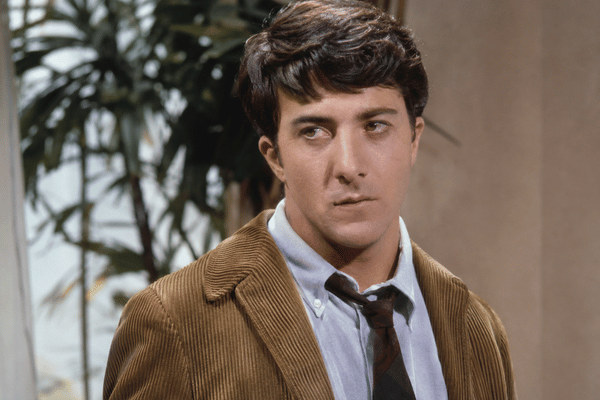
Nearly 60 years after *The Graduate* transformed him into a Hollywood star, Dustin Hoffman is opening up about the difficult experience behind one of cinema’s most celebrated films.
The Oscar-winning actor has revealed that working on the 1967 comedy-drama was filled with anxiety, self-doubt and uncomfortable encounters with director Mike Nichols. In a personal essay published by *The New Yorker*, Hoffman describes a production that changed his professional life while leaving him with painful memories.
Hoffman was relatively unknown in Hollywood when he landed the role of Benjamin Braddock, a recent college graduate struggling with uncertainty about his future. Although the performance would establish him as a major talent, the actor initially believed he was completely unsuitable for the part.
The character in Charles Webb’s original novel was portrayed as a privileged young man with an impressive academic and athletic background. Hoffman, who felt his appearance and Jewish heritage made him an unconventional choice, questioned why he would even be considered.
His agent eventually persuaded him to audition, and Nichols selected him for the leading role. However, receiving the opportunity did little to ease his concerns.
According to Hoffman, the director’s behavior changed noticeably once production began. While Nichols had been encouraging and insightful during rehearsals, the atmosphere on set became considerably more difficult.
Hoffman recalls frequently questioning his own performance and interpreting the director’s frustration as a sign that he might be replaced. The uncertainty followed him through scenes that would eventually become some of the most recognizable moments in American cinema.
One incident remains especially troubling in the actor’s memory.
During a confrontation between Benjamin and Elaine Robinson, played by Katharine Ross, Nichols instructed Ross to slap Hoffman repeatedly. The scene required 27 takes, with the director reportedly pushing for increasingly forceful reactions.
Hoffman remembers Ross expressing concern about injuring him. Although he encouraged her to continue, he specifically wanted her to avoid striking his ear.
By the end of the filming session, the actor says he was experiencing dizziness. Despite the demanding work involved, the slap itself was ultimately excluded from the completed movie.
The following day, Hoffman filmed an underwater sequence involving scuba equipment. After several takes, he discovered blood coming from his ear. He believes the combination of the previous day’s repeated blows and underwater pressure caused a punctured eardrum.
The experience added a physical injury to an already stressful production.
Yet the film’s eventual reception could hardly have been more different from the uncertainty Hoffman experienced while making it.
Released in December 1967, *The Graduate* became a major commercial and critical success. Its exploration of generational conflict, complicated relationships and the uncertainties of adulthood helped establish it as a defining film of its era.
The movie also featured memorable performances from Anne Bancroft and Katharine Ross, alongside a soundtrack closely associated with Simon & Garfunkel.
It received seven Academy Award nominations, including Best Picture and Best Actor for Hoffman. Nichols won the Oscar for Best Director.
For Hoffman, the success opened the door to a remarkable career that would eventually include Academy Award-winning performances in *Kramer vs. Kramer* and *Rain Man*.
His latest reflections reveal an important contrast between the finished film and the experience of creating it.
What audiences remember as a breakthrough performance was, for the actor delivering it, a period marked by insecurity, demanding working conditions and a constant fear of failure.
Decades later, Hoffman can recognize the extraordinary opportunity that *The Graduate* provided without overlooking the difficulties he endured along the way.
The film remains a Hollywood classic, but its leading man remembers that the road to success was considerably less enjoyable than the finished product might suggest.
