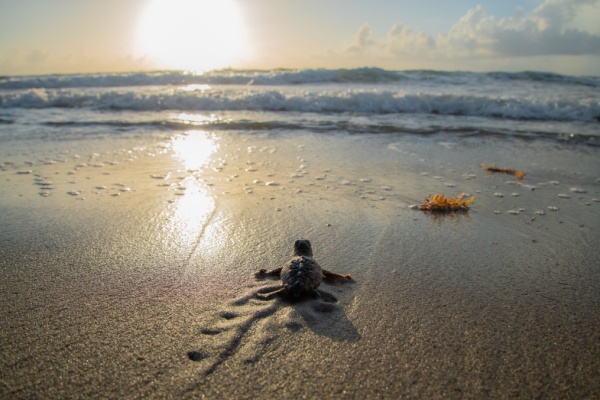
Animal and nature lovers in Southern California – indeed, around the country – are all officially on sea turtle watch, as Long Beach Aquarium of the Pacific officials are preparing for what could be the first-ever hatching of sea turtle eggs laid on a Southern California beach.
As CBS News reports, the olive ridley turtle eggs were laid on Seal Beach and Huntington Beach in late September, marking the first time in recorded history that wildlife officials tracked turtle nesting in the region, possibly brought on by the shifting patterns in the Pacific Ocean brought on by this year’s Super El Niño.
Following the unexpected “gift,” Aquarium officials then quickly relocated the eggs to protect them from hazards that could harm their well-being, including exceptionally high tides in recent months. Overall, wildlife officials carefully transplanted 204 eggs from the beach into their care.
About the Olive Ridley Sea Turtle
According to the National Oceanic and Atmospheric Administration (NOAA), the olive ridley gets its name from the olive green color of its heart-shaped shell. This species is among the smallest, but the most widespread and abundant of the world’s sea turtles. Olive ridleys have two nesting strategies: solitary or mass nesting (arribada). An arribada refers to the phenomenon of synchronized mass nesting of thousands, if not tens of thousands, of olive ridleys.
Olive ridleys are found throughout the world primarily in the tropical regions of the Pacific, Indian, and Atlantic oceans. The number of olive ridleys is greatly reduced from historical estimates, which suggest that up to 10 million olive ridleys once roamed the Pacific Ocean. Today, just a handful of mass nesting (arribada) beaches account for the largest numbers of nesting females. Bycatch in fishing gear and the direct harvest of turtles and eggs are the most significant threats facing olive ridleys.
Why All the Fuss Over Some Turtle Eggs?
NOAA Fisheries states that while olive ridley turtles are found worldwide – in the Atlantic, Indian, and Pacific Oceans – they are listed under the Endangered Species Act. Their breeding colony populations on the Pacific Coast of Mexico are listed as endangered; all others are listed as threatened.
According to the International Union for Conservation of Nature and Natural Resources Red List, there has been anywhere from a 30 to 36 percent reduction in global population size over the last century. Although some nesting populations have increased in the past few years or are currently stable, the overall reduction in some populations is greater than the overall increase in others.
In the Pacific, large nesting populations normally occur in Mexico, Nicaragua, Costa Rica, and Panama. For example, an arribada nesting beach in La Escobilla, Mexico hosts an estimated 450,000 nesting female turtles, and the Pacific coast of Costa Rica supports an estimated 600,000 nesting olive ridleys between its two major arribada beaches, Nancite and Ostional.
So the fact that these 200+ eggs showed up on a beach in Southern California is a big deal.
The Hatching Window Has Begun
Now marine wildlife experts say the window for possible hatching has begun.
Since their relocation, officials have stored the eggs in a 90-degree room at the aquarium, typically their recovery room, while closely monitoring their progress. “The best-case scenario, I think, is that we get a reasonable hatching rate, maybe somewhere from a quarter and a half of the eggs developing and then hatching,” said Dr. Lance Adams, the Director of Veterinary Medicine at the aquarium.
He said that if the eggs stayed on the beach, the chance of survival would have been much lower. “We remain optimistic, but also realistic,” Adams said, adding that they’re not sure if the eggs have been developing properly. “We’re all standing by waiting to see what happens.”
If the eggs hatch, specialists will transport the turtles to the ocean as quickly as possible to give them the best chance of survival.
—
Photo Credit: Andre-Johnson / Shutterstock.com
